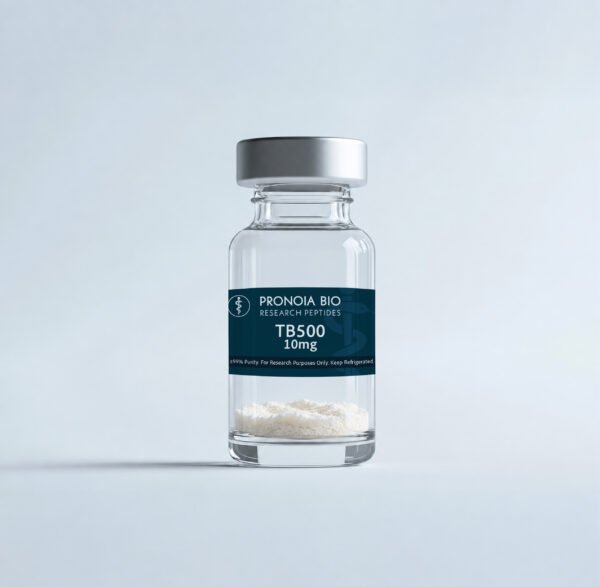
Description
About TB-500
TB-500 is a synthetic N-terminally acetylated seven-amino-acid research peptide associated with the central actin-binding region of Thymosin Beta-4.
The peptide has the sequence Ac-Leu-Lys-Lys-Thr-Glu-Thr-Gln-OH, commonly represented as Ac-LKKTETQ, and corresponds to residues 17–23 of the 43-amino-acid Thymosin Beta-4 protein.
This distinction is important: TB-500 is a defined fragment derived from the Thymosin Beta-4 sequence and should not be treated as identical to full-length Thymosin Beta-4.
The LKKTETQ region has attracted research interest because it forms part of the actin-binding domain of Thymosin Beta-4. Actin is a major component of the cellular cytoskeleton and plays fundamental roles in cell shape, adhesion, movement and structural reorganisation.
Experimental research involving the Thymosin Beta-4 actin-binding region has examined endothelial-cell migration, vessel-sprouting models, cellular motility and tissue-repair-associated biology.
More recent research has also investigated the metabolism of N-acetylated TB-500 itself and whether biological activity observed in experimental systems may differ between the parent peptide and its metabolites.
Pronoia supplies TB-500 in a 10mg lyophilised research format with batch traceability and supporting documentation available for the supplied material.
Product Specification
Product: TB-500
Descriptor: Thymosin Beta-4 fragment
Strength: 10mg
Peptide class: Synthetic N-terminally acetylated heptapeptide
Parent framework: Thymosin Beta-4 residues 17–23
Peptide length: 7 amino acids
Sequence: Ac-Leu-Lys-Lys-Thr-Glu-Thr-Gln-OH
Sequence notation: Ac-LKKTETQ
Research region: Thymosin Beta-4 actin-binding motif
Research focus: Actin-associated cell movement, cytoskeletal dynamics, endothelial behaviour and fragment metabolism
Form: Lyophilised solid
Pronoia minimum purity standard: ≥99%
Batch traceability: Maintained
SKU: PB-TB500-10
Testing & Batch Documentation
Pronoia maintains a structured quality, testing and traceability process for TB-500, with supporting documentation retained for the supplied research material.
- Batch-tested research material
- Pronoia minimum accepted purity standard of ≥99%
- Full batch traceability
- Batch-separated and labelled inventory
- Physical inventory routinely reconciled with digital stock records
- Temperature-controlled cold storage
- Certificate of Analysis (COA) and Safety Data Sheet (SDS) documentation available
Because TB-500 and full-length Thymosin Beta-4 are distinct peptide materials, the applicable Certificate of Analysis should be treated as the authoritative reference for the exact sequence, chemical form, identity, purity and analytical results reported for an individual batch.
Research Context
TB-500 is investigated principally as a defined peptide fragment derived from the central actin-binding region of Thymosin Beta-4.
Understanding its research context requires distinguishing experimental findings involving TB-500 itself from findings involving the full 43-amino-acid Thymosin Beta-4 protein.
TB-500 and Thymosin Beta-4 identity
Full-length Thymosin Beta-4 is a 43-amino-acid protein involved extensively in actin biology.
TB-500 is substantially smaller.
Analytical research on commercial material described as TB-500 identified the principal peptide as the N-terminally acetylated sequence:
Ac-Leu-Lys-Lys-Thr-Glu-Thr-Gln
or:
Ac-LKKTETQ
This sequence corresponds to residues 17–23 of Thymosin Beta-4.
TB-500 should therefore be described as a Thymosin Beta-4-derived fragment rather than simply as another name for the complete protein.
Actin and cytoskeletal biology
Actin is one of the principal structural proteins forming the cellular cytoskeleton.
Dynamic rearrangement of actin contributes to:
- Cell shape
- Cell migration
- Cell spreading
- Adhesion
- Membrane movement
- Intracellular structural organisation
Full-length Thymosin Beta-4 is well characterised as an important G-actin-binding and actin-sequestering protein.
Research mapping its structure identified the central LKKTETQ region as an important actin-associated sequence.
This relationship provides the principal mechanistic basis for studying TB-500 and related fragments in cellular-movement and tissue-response models.
Cell migration and endothelial research
Experimental research has investigated the contribution of the Thymosin Beta-4 actin-binding region to endothelial-cell behaviour.
Studies using full-length Thymosin Beta-4 together with synthetic fragments reported that the seven-amino-acid actin-binding motif could reproduce important aspects of endothelial activity under the experimental conditions studied.
Reported findings included:
- Increased endothelial-cell migration
- Changes in cellular adhesion
- Increased vessel-sprouting activity in experimental models
- Angiogenesis-associated cellular responses
These studies provide direct evidence that the short actin-binding region carries biologically relevant activity independently of the complete 43-amino-acid protein.
However, the exact sequence and terminal modifications used in individual experiments must be considered when comparing those findings with N-acetylated TB-500.
Tissue-repair models
The Thymosin Beta-4 actin-binding sequence has also been studied in preclinical wound-repair models.
In aged-animal experiments, a synthetic seven-amino-acid LKKTETQ peptide produced changes in wound-repair measures comparable with those reported for full-length Thymosin Beta-4 under the experimental conditions used.
Research endpoints included processes such as:
- Cell migration
- Wound contraction
- Collagen deposition
- Repair-associated tissue organisation
These findings explain why the TB-500 / Thymosin Beta-4-fragment research field is frequently associated with tissue-repair biology.
They should not, however, be interpreted as evidence that every chemically modified version of the fragment produces identical effects.
Full-length Thymosin Beta-4 research
The complete Thymosin Beta-4 protein has a much larger experimental literature than TB-500 itself.
Published research involving full-length Tβ4 has examined:
- Endothelial-cell migration
- Angiogenesis
- Cellular differentiation
- Inflammatory signalling
- Matrix-associated processes
- Wound-repair models
- Hair-follicle-associated biology
Full-length Thymosin Beta-4 has also been investigated across several signalling systems including VEGF-, Notch- and Akt-associated pathways.
These findings are scientifically relevant to understanding the biological role of the parent protein but should not automatically be presented as direct experimental findings for TB-500.
TB-500 metabolism
More recent research has examined N-acetylated TB-500 itself rather than relying solely on studies of full-length Thymosin Beta-4 or the unacetylated LKKTETQ sequence.
A 2024 study characterised TB-500 as Ac-LKKTETQ and investigated its metabolism in serum, enzyme systems and rats.
Researchers identified several shorter metabolites, including Ac-LK and Ac-LKK.
When the parent peptide and metabolites were examined in an in-vitro fibroblast wound-healing assay, the investigators reported significant wound-healing activity for the metabolite Ac-LKKTE rather than for the parent TB-500 peptide.
This finding is important because it suggests that biological effects associated with TB-500 in an experimental system may depend partly on peptide metabolism rather than necessarily being caused directly by the intact parent sequence.
It also reinforces why results involving full-length Thymosin Beta-4, unacetylated LKKTETQ and N-acetylated TB-500 should not be treated as interchangeable.
TB-500 versus full-length Thymosin Beta-4
For research interpretation, these materials should be kept separate:
- Thymosin Beta-4: full 43-amino-acid protein
- LKKTETQ: seven-residue actin-binding sequence within Tβ4
- TB-500: N-terminally acetylated Ac-LKKTETQ fragment identified in analytical research
Although they occupy related biological territory, differences in peptide length and terminal modification can alter stability, metabolism and experimental activity.
Interpreting the TB-500 evidence base
The strongest research rationale surrounding TB-500 currently includes:
- Thymosin Beta-4 fragment biology
- Actin-associated cellular processes
- Cytoskeletal dynamics
- Cell migration and motility
- Endothelial and vessel-sprouting models
- Tissue-repair-associated experimental systems
- Peptide metabolism and metabolite activity
A substantial proportion of the broader regenerative literature concerns full-length Thymosin Beta-4 or related non-acetylated peptide sequences rather than N-acetylated TB-500 itself.
Pronoia therefore distinguishes those evidence sources rather than assuming that every effect reported for the parent protein has been demonstrated for TB-500.
The available evidence does not establish clinical efficacy, safety or suitability for human or veterinary use.
Storage & Handling
TB-500 is supplied in lyophilised form and should be stored according to the conditions specified by Pronoia and the applicable batch documentation.
Pronoia stock is maintained in temperature-controlled cold storage and organised by identifiable batch prior to dispatch.
The material should be protected from unnecessary exposure to heat, moisture and light and handled using appropriate laboratory procedures.
Where batch-specific storage or handling information is supplied, that information should take precedence.
UK Delivery
TB-500 is dispatched from Pronoia’s UK stock using tracked delivery.
Current availability and dispatch information are shown directly on the product page, with tracking supplied following dispatch.
Orders are prepared through Pronoia’s established research-product fulfilment process, with applicable delivery conditions remaining subject to Pronoia’s current delivery terms.
Research Use
TB-500 supplied by Pronoia Bio is intended for laboratory research and experimental use only.
It is not supplied for human or veterinary use and should not be treated as a medicine, injury-recovery product or consumer healthcare product.
Pronoia does not provide dosage, treatment or administration guidance for this research material.