Description
About CJC-1295 Without DAC
CJC-1295 Without DAC is the catalogue name commonly used for Modified GRF (1-29), also known as Mod GRF (1-29) or tetrasubstituted GRF (1-29).
It is a synthetic 29-amino-acid analogue of the active 1–29 region of growth hormone-releasing hormone (GHRH). GHRH is a signalling peptide that activates receptors on pituitary cells involved in growth-hormone release.
Modified GRF (1-29) incorporates four targeted amino-acid substitutions relative to the parent GRF (1-29) sequence. These modifications have made the peptide relevant to research examining how sequence changes can influence enzymatic stability, receptor signalling and the persistence of GHRH-related activity.
Unlike CJC-1295 With DAC, this material does not contain the Drug Affinity Complex responsible for albumin binding and prolonged circulation. The two products therefore represent distinct experimental formats for studying shorter-duration versus extended-duration GHRH-related signalling.
Together, these characteristics make CJC-1295 Without DAC relevant to research examining GHRH-receptor activity, growth-hormone release, peptide stability and structure–activity relationships within the growth-hormone axis.
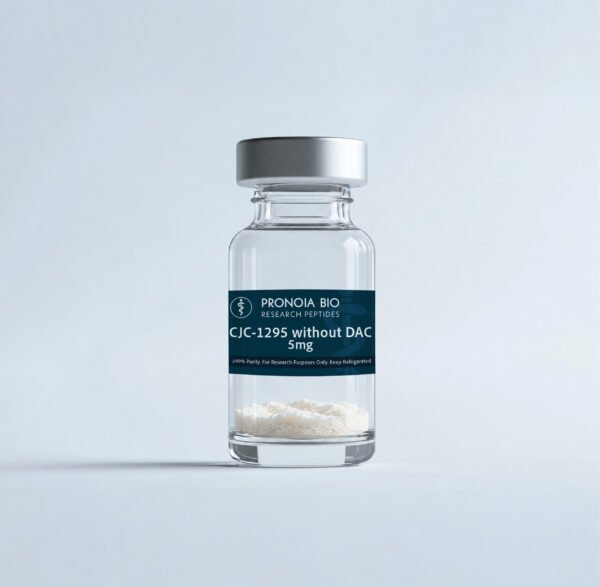
Pronoia supplies CJC-1295 Without DAC in a 5mg lyophilised research format with batch traceability and supporting documentation available for the supplied material.
Product Specification
Product: CJC-1295 Without DAC
Preferred chemical reference: Modified GRF (1-29)
Alternative names: Mod GRF (1-29); tetrasubstituted GRF (1-29)
Strength: 5mg
Material class: Modified GHRH analogue
Parent framework: GHRH / GRF (1-29)-derived peptide
Peptide length: 29 amino acids
Sequence substitutions: D-Ala², Gln⁸, Ala¹⁵ and Leu²⁷
DAC modification: Not present
Research characteristic: Modified, non-albumin-binding GHRH analogue
Research focus: GHRH-receptor signalling, GH release, peptide stability and shorter-duration signalling
Form: Lyophilised solid
Pronoia minimum purity standard: ≥99%
Batch traceability: Maintained
SKU: PB-CJC-5
Testing & Batch Documentation
Pronoia maintains a structured quality, testing and traceability process for CJC-1295 Without DAC, with supporting documentation retained for the supplied research material.
- Batch-tested research material
- Pronoia minimum accepted purity standard of ≥99%
- Full batch traceability
- Batch-separated and labelled inventory
- Physical inventory routinely reconciled with digital stock records
- Temperature-controlled cold storage
- Certificate of Analysis (COA) and Safety Data Sheet (SDS) documentation available
The applicable Certificate of Analysis should be treated as the authoritative reference for the identity, purity and analytical results reported for an individual batch.
Research Context
Modified GRF (1-29) belongs to a wider class of experimental analogues derived from the biologically active 1–29 region of growth hormone-releasing hormone.
The parent GRF (1-29) sequence can activate the GHRH receptor and stimulate growth-hormone release, but it is susceptible to rapid enzymatic degradation. Researchers have therefore investigated amino-acid substitutions designed to preserve receptor activity while changing peptide stability and metabolic clearance.
The material commonly described as CJC-1295 Without DAC incorporates four substitutions relative to GRF (1-29):
- D-Ala at position 2
- Gln at position 8
- Ala at position 15
- Leu at position 27
These changes form the tetrasubstituted Modified GRF (1-29) sequence and provide a useful model for studying how relatively small structural changes can alter the behaviour of a GHRH-related peptide.
Research into modified GHRH analogues has examined:
- Activation of the GHRH receptor and stimulation of growth-hormone release
- Resistance to enzymatic degradation
- Changes in metabolic clearance and peptide persistence
- Effects of specific amino-acid substitutions on biological activity
- Structure–activity relationships across GHRH-derived peptides
Human pharmacokinetic research involving a GRF (1-29) analogue containing the D-Ala² substitution demonstrated reduced metabolic clearance and a longer disappearance half-time than unmodified GRF (1-29), illustrating how modification at a single degradation-sensitive position can influence peptide persistence.
The complete tetrasubstituted Modified GRF (1-29) material should nevertheless be distinguished from individual modified GHRH analogues investigated in earlier studies. Findings from one analogue should not automatically be treated as exact pharmacokinetic measurements for another.
This distinction is particularly important when comparing CJC-1295 Without DAC with CJC-1295 With DAC. The DAC-containing form incorporates an albumin-binding modification designed for substantially prolonged circulation, whereas Modified GRF (1-29) lacks that albumin-binding system.
CJC-1295 Without DAC is therefore relevant to experimental systems examining comparatively shorter-duration GHRH signalling, receptor activation, peptide degradation and the relationship between molecular structure and signalling persistence.
The available evidence does not establish clinical efficacy or suitability for human or veterinary use.
Storage & Handling
CJC-1295 Without DAC is supplied in lyophilised form and should be stored according to the conditions specified by Pronoia and the applicable batch documentation.
Pronoia stock is maintained in temperature-controlled cold storage and organised by identifiable batch prior to dispatch.
The material should be protected from unnecessary exposure to heat, moisture and light and handled using appropriate laboratory procedures.
Where batch-specific storage or handling information is supplied, that information should take precedence.
UK Delivery
CJC-1295 Without DAC is dispatched from Pronoia’s UK stock using tracked delivery.
Current availability and dispatch information are shown directly on the product page, with tracking supplied following dispatch.
Orders are prepared through Pronoia’s established research-product fulfilment process, with applicable delivery conditions remaining subject to Pronoia’s current delivery terms.
Research Use
CJC-1295 Without DAC supplied by Pronoia Bio is intended for laboratory research and experimental use only.
It is not supplied for human or veterinary use and should not be treated as a medicine or consumer healthcare product.
Pronoia does not provide dosage, treatment or administration guidance for this research material.