Description
About Ipamorelin
Ipamorelin is a synthetic five-amino-acid growth-hormone secretagogue with the sequence Aib-His-D-2-Nal-D-Phe-Lys-NH₂.
It belongs to the growth-hormone secretagogue peptide family and has been investigated for its ability to stimulate growth-hormone release through the receptor system now known as the ghrelin receptor, or GHS-R1a.
Growth-hormone secretagogues activate signalling at pituitary and hypothalamic receptor systems involved in regulating GH secretion. Ipamorelin became particularly notable in experimental research because it produced strong GH-releasing activity while showing a more selective endocrine profile than several earlier GHRP-class peptides.
In comparative preclinical research, Ipamorelin stimulated GH release without producing the same increases in ACTH and cortisol observed with GHRP-2 and GHRP-6 under the experimental conditions used.
Controlled human pharmacology studies have also investigated its growth-hormone response and pharmacokinetic behaviour, making Ipamorelin relevant to research examining pituitary signalling, GH-release dynamics, receptor selectivity and peptide pharmacokinetics.
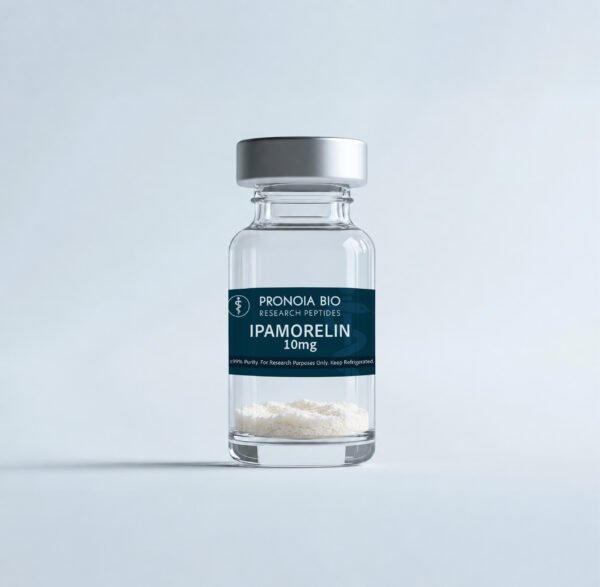
Pronoia supplies Ipamorelin in a 10mg lyophilised research format with batch traceability and supporting documentation available for the supplied material.
Product Specification
Product: Ipamorelin
Strength: 10mg
Peptide class: Synthetic pentapeptide / growth-hormone secretagogue
Peptide length: 5 amino acids
Sequence: Aib-His-D-2-Nal-D-Phe-Lys-NH₂
Research target: Ghrelin receptor / GHS-R1a pathway
Research characteristic: Selective growth-hormone secretagogue profile
Research focus: Growth-hormone release, pituitary signalling, GH-release kinetics and endocrine selectivity
Form: Lyophilised solid
Pronoia minimum purity standard: ≥99%
Batch traceability: Maintained
SKU: PB-IPA-10
Testing & Batch Documentation
Pronoia maintains a structured quality, testing and traceability process for Ipamorelin, with supporting documentation retained for the supplied research material.
- Batch-tested research material
- Pronoia minimum accepted purity standard of ≥99%
- Full batch traceability
- Batch-separated and labelled inventory
- Physical inventory routinely reconciled with digital stock records
- Temperature-controlled cold storage
- Certificate of Analysis (COA) and Safety Data Sheet (SDS) documentation available
The applicable Certificate of Analysis should be treated as the authoritative reference for the identity, purity and analytical results reported for an individual batch.
Research Context
Ipamorelin was developed during research into synthetic growth-hormone secretagogues — compounds designed to stimulate pituitary growth-hormone release through signalling pathways distinct from the classical growth hormone-releasing hormone (GHRH) receptor.
The active receptor associated with this secretagogue system is now known as the ghrelin receptor, or GHS-R1a, a G-protein-coupled receptor expressed within the hypothalamic–pituitary system and other tissues.
Ipamorelin is a synthetic pentapeptide containing several modified amino-acid residues:
Aib-His-D-2-Nal-D-Phe-Lys-NH₂
Its compact structure and receptor pharmacology have made it useful in experimental studies examining how peptide structure influences growth-hormone-secretagogue activity.
Growth-hormone release
Early laboratory experiments using primary rat pituitary cells demonstrated concentration-dependent GH release following Ipamorelin exposure.
Researchers reported growth-hormone-releasing potency and efficacy comparable to GHRP-6 under the experimental conditions used.
Subsequent in vivo experiments in rats and swine also demonstrated substantial GH responses, confirming that the peptide retained secretagogue activity across multiple experimental systems.
These studies established Ipamorelin as relevant to research examining:
- Pituitary growth-hormone release
- Ghrelin / GHS-R1a receptor signalling
- Growth-hormone secretagogue structure–activity relationships
- Comparative pharmacology of GHRP-class peptides
Endocrine selectivity
One of the characteristics that distinguished Ipamorelin from several earlier growth-hormone-releasing peptides was its experimental endocrine-selectivity profile.
In comparative swine studies, GHRP-2 and GHRP-6 stimulated GH release but also increased circulating ACTH and cortisol.
Ipamorelin produced substantial GH release without ACTH or cortisol concentrations significantly exceeding those observed following GHRH stimulation, even when studied at doses substantially above those required for GH release.
Researchers therefore described Ipamorelin as the first GHRP-receptor agonist in that experimental series to show a degree of selectivity for GH release approaching that observed with GHRH.
This makes Ipamorelin particularly relevant to studies attempting to distinguish growth-hormone-secretagogue signalling from broader pituitary or adrenal-axis responses.
Human pharmacokinetic and GH-response research
Ipamorelin has also been investigated in controlled human pharmacokinetic and pharmacodynamic research.
In a dose-escalation study involving healthy male volunteers, researchers measured circulating Ipamorelin concentrations alongside growth-hormone responses.
Under the study conditions they reported:
- Dose-proportional pharmacokinetic behaviour
- A terminal plasma half-life of approximately 2 hours
- A single measurable episode of growth-hormone release following exposure
- Peak GH concentrations at approximately 0.67 hours
- A subsequent decline towards negligible GH concentrations across the experimental period
These observations provide a defined research framework for examining the relationship between circulating Ipamorelin concentrations and pituitary GH responses.
The findings should not be interpreted as establishing an administration schedule or personal-use guidance; they describe pharmacokinetic and pharmacodynamic measurements from a controlled research study.
Downstream GH-axis research
Preclinical studies have also used Ipamorelin to investigate downstream biological responses associated with repeated growth-hormone-secretagogue signalling.
In adult rat models, researchers reported dose-dependent increases in longitudinal bone-growth rate during the experimental period together with changes in body-weight gain.
Interestingly, circulating total IGF-I, IGF-binding proteins and measured markers of bone formation and resorption were not significantly altered in the same experiment.
These findings illustrate that downstream responses within the GH axis can involve more complex biology than changes in a single circulating marker and provide an additional experimental context for Ipamorelin research.
Together, the evidence makes Ipamorelin relevant to laboratory and preclinical studies examining GH secretion, ghrelin-receptor signalling, endocrine selectivity, peptide pharmacokinetics and downstream GH-axis biology.
The published evidence consists primarily of laboratory, animal and early controlled human pharmacology research. It does not establish clinical efficacy, safety or suitability for human or veterinary use.
Storage & Handling
Ipamorelin is supplied in lyophilised form and should be stored according to the conditions specified by Pronoia and the applicable batch documentation.
Pronoia stock is maintained in temperature-controlled cold storage and organised by identifiable batch prior to dispatch.
The material should be protected from unnecessary exposure to heat, moisture and light and handled using appropriate laboratory procedures.
Where batch-specific storage or handling information is supplied, that information should take precedence.
UK Delivery
Ipamorelin is dispatched from Pronoia’s UK stock using tracked delivery.
Current availability and dispatch information are shown directly on the product page, with tracking supplied following dispatch.
Orders are prepared through Pronoia’s established research-product fulfilment process, with applicable delivery conditions remaining subject to Pronoia’s current delivery terms.
Research Use
Ipamorelin supplied by Pronoia Bio is intended for laboratory research and experimental use only.
It is not supplied for human or veterinary use and should not be treated as a medicine or consumer healthcare product.
Pronoia does not provide dosage, treatment or administration guidance for this research material.