Description
About Oxytocin
Oxytocin is a cyclic nine-amino-acid neuropeptide hormone with the sequence Cys-Tyr-Ile-Gln-Asn-Cys-Pro-Leu-Gly-NH₂.
Its structure contains a disulfide bridge between the two cysteine residues, creating a six-residue cyclic region followed by a short C-terminal tail.
Oxytocin functions principally through the oxytocin receptor (OXTR), a G-protein-coupled receptor expressed across a range of central and peripheral tissues.
OXTR activation can trigger intracellular signalling involving phospholipase C, inositol trisphosphate and changes in intracellular calcium. This provides a molecular basis for several of oxytocin’s best-established experimental effects, including contraction of uterine smooth muscle and contraction of mammary myoepithelial cells.
Oxytocin is also an important neuroendocrine signalling molecule within the central nervous system. Research has examined its involvement in social recognition, affiliative behaviour, emotional processing, stress responses and interactions with wider neurotransmitter and neuropeptide systems.
These different biological roles make oxytocin relevant to research spanning receptor pharmacology, calcium signalling, reproductive physiology, neuroendocrine regulation and social-behavioural neuroscience.
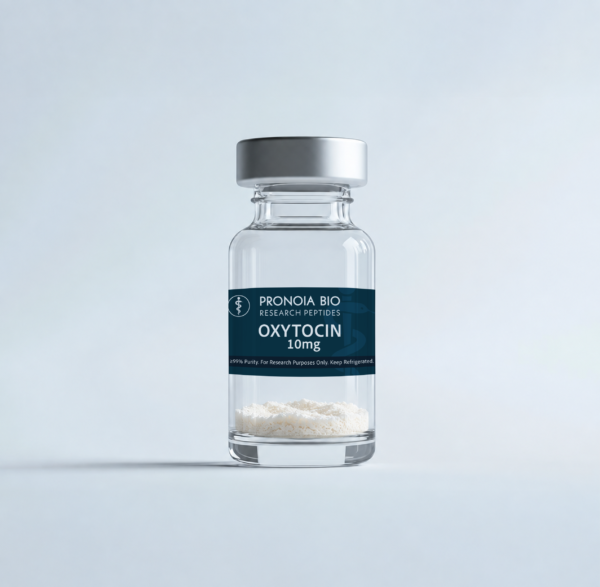
Pronoia supplies Oxytocin in a 5mg lyophilised research format with batch traceability and supporting documentation available for the supplied material.
Product Specification
Product: Oxytocin
Strength: 10mg
Peptide class: Synthetic cyclic nonapeptide / neuropeptide hormone
Peptide length: 9 amino acids
Sequence: Cys-Tyr-Ile-Gln-Asn-Cys-Pro-Leu-Gly-NH₂
Sequence notation: CYIQNCPLG-NH₂
Structural feature: Cys¹–Cys⁶ disulfide bridge
C-terminal modification: Amidated
Primary research target: Oxytocin receptor (OXTR)
Research focus: OXTR signalling, calcium-dependent cellular responses, smooth-muscle and myoepithelial contraction, reproductive neuroendocrine biology and central behavioural signalling
Form: Lyophilised solid
Pronoia minimum purity standard: ≥99%
Batch traceability: Maintained
SKU: PB-OXY-10
Testing & Batch Documentation
Pronoia maintains a structured quality, testing and traceability process for Oxytocin, with supporting documentation retained for the supplied research material.
- Batch-tested research material
- Pronoia minimum accepted purity standard of ≥99%
- Full batch traceability
- Batch-separated and labelled inventory
- Physical inventory routinely reconciled with digital stock records
- Temperature-controlled cold storage
- Certificate of Analysis (COA) and Safety Data Sheet (SDS) documentation available
The applicable Certificate of Analysis should be treated as the authoritative reference for the chemical form, identity, purity and analytical results reported for an individual batch.
Research Context
Oxytocin has been investigated extensively as both a peripheral peptide hormone and a central neuropeptide.
Its biological effects are mediated primarily through the oxytocin receptor (OXTR), a seven-transmembrane G-protein-coupled receptor.
OXTR and intracellular calcium signalling
One of the best-characterised oxytocin signalling pathways involves coupling of OXTR to Gαq/11 proteins.
Receptor activation can stimulate phospholipase C, leading to production of inositol trisphosphate (IP₃) and diacylglycerol (DAG).
IP₃ can promote release of calcium from intracellular stores, while additional signalling mechanisms can influence calcium entry across the cell membrane.
The resulting increase in intracellular calcium can activate downstream systems involved in cellular contraction and other physiological responses.
Oxytocin-receptor research has therefore examined:
- OXTR activation and receptor pharmacology
- Gαq/11-coupled signalling
- Phospholipase C activity
- IP₃ and intracellular calcium mobilisation
- Protein kinase C and MAPK-associated signalling
- Receptor regulation and desensitisation
Smooth-muscle and reproductive physiology
Oxytocin has a particularly well-established role in experimental studies of uterine smooth-muscle biology.
Within uterine myometrial cells, OXTR activation can increase intracellular calcium and increase sensitivity of the contractile machinery to calcium.
These mechanisms contribute to changes in contraction frequency and force.
Research in this area has examined:
- Myometrial OXTR expression
- Calcium mobilisation
- Smooth-muscle contraction
- Receptor sensitisation and desensitisation
- Changes in OXTR signalling across reproductive physiological states
This provides one of the clearest experimental examples of how oxytocin receptor activation translates from molecular signalling into a measurable tissue response.
Mammary myoepithelial and milk-ejection research
Oxytocin also plays a central role in mammary-gland neuroendocrine physiology.
During the endogenous milk-ejection reflex, oxytocin released from hypothalamic neurosecretory pathways acts on receptors expressed by myoepithelial cells surrounding the mammary alveoli.
OXTR signalling increases intracellular calcium within these cells and promotes contraction.
Contraction of the myoepithelial layer moves milk from the alveolar compartments into the ductal system.
Experimental research has therefore used oxytocin to examine:
- Myoepithelial-cell contraction
- Calcium-dependent contractile signalling
- Neuroendocrine reflex mechanisms
- Mammary-gland cellular physiology
- Receptor-dependent tissue responses
Central neuroendocrine signalling
Oxytocin is synthesised principally within hypothalamic neuronal populations, including neurons associated with the paraventricular and supraoptic nuclei.
Beyond its peripheral endocrine actions, oxytocin released within the nervous system participates in neuromodulatory signalling.
Experimental research has examined oxytocin in relation to:
- Social recognition and social salience
- Affiliative and attachment-related behaviour
- Reward and motivational processing
- Stress and anxiety-related signalling
- Maternal and reproductive behaviour
- Interactions with dopamine, vasopressin and other neuromodulatory systems
These behavioural areas require considerably more careful interpretation than oxytocin’s well-characterised peripheral contractile physiology.
Human studies have produced context-dependent findings, and oxytocin should not be interpreted simply as a universal “bonding” or “trust” hormone.
Recent reviews emphasise that behavioural responses can depend on the individual, social environment, experimental design and interactions with other neurotransmitter and neuropeptide systems.
Research measuring endogenous oxytocin concentrations in humans has also produced inconsistent findings, in part because of methodological differences in measurement and study design.
For these reasons, Pronoia describes social and behavioural biology as an active research area rather than presenting specific behavioural outcomes as universal effects.
Oxytocin and vasopressin receptor pharmacology
Oxytocin and vasopressin are structurally related neuropeptides, and their receptor families share substantial molecular similarity.
OXTR is the primary receptor associated with oxytocin signalling, but ligand selectivity across oxytocin and vasopressin receptor systems is not absolute.
Experimental receptor responses can vary according to ligand concentration, receptor subtype, tissue and species.
This is particularly relevant in pharmacological studies where researchers aim to attribute a response specifically to OXTR rather than to related vasopressin-receptor activity.
Oxytocin is therefore useful not only as a neuroendocrine peptide but also as a research material for investigating receptor selectivity and structure–activity relationships within the wider oxytocin/vasopressin signalling family.
Together, the available evidence makes oxytocin particularly relevant to research examining receptor pharmacology, intracellular calcium signalling, smooth-muscle and myoepithelial physiology, reproductive neuroendocrine systems and central neuromodulatory biology.
The published evidence spans molecular, cell-based, animal and human experimental research. Findings from one biological context should not automatically be generalised to another, and they do not establish clinical efficacy, safety or suitability for human or veterinary use.
Storage & Handling
Oxytocin is supplied in lyophilised form and should be stored according to the conditions specified by Pronoia and the applicable batch documentation.
Pronoia stock is maintained in temperature-controlled cold storage and organised by identifiable batch prior to dispatch.
The material should be protected from unnecessary exposure to heat, moisture and light and handled using appropriate laboratory procedures.
Solubility and preparation conditions can depend on concentration and the exact supplied chemical form. Researchers should therefore use validated laboratory procedures and applicable batch-specific documentation rather than relying on a universal preparation method.
Where batch-specific storage or handling information is supplied, that information should take precedence.
UK Delivery
Oxytocin is dispatched from Pronoia’s UK stock using tracked delivery.
Current availability and dispatch information are shown directly on the product page, with tracking supplied following dispatch.
Orders are prepared through Pronoia’s established research-product fulfilment process, with applicable delivery conditions remaining subject to Pronoia’s current delivery terms.
Research Use
Oxytocin supplied by Pronoia Bio is intended for laboratory research and experimental use only.
It is not supplied for human or veterinary use and should not be treated as a medicine or consumer healthcare product.
Pronoia does not provide dosage, treatment or administration guidance for this research material.