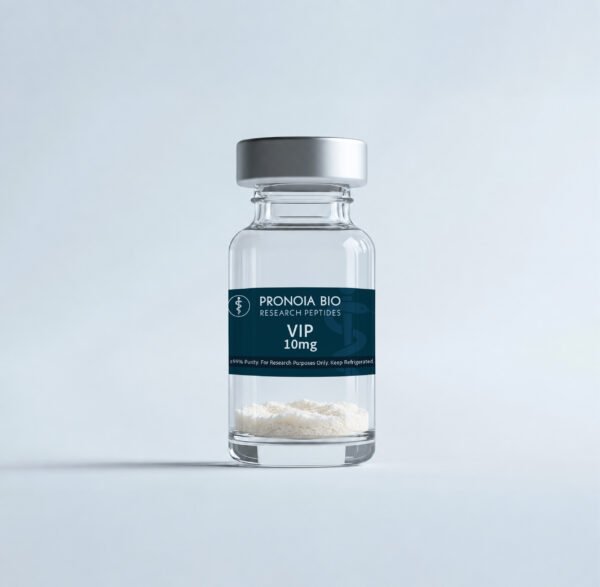
Description
About VIP
Vasoactive intestinal peptide (VIP) is an endogenous 28-amino-acid neuropeptide belonging to the secretin-family peptide signalling system.
VIP is distributed across central and peripheral biological systems and has a broad research history spanning neuroendocrine communication, autonomic and smooth-muscle signalling, vascular biology and immune-cell regulation.
Its principal recognised receptors are VPAC1 and VPAC2, members of the class-B G-protein-coupled receptor family. Activation of these receptors is strongly associated with adenylyl-cyclase and cyclic-AMP signalling.
This receptor framework makes VIP particularly relevant to experimental investigation of peptide-mediated cellular communication and the way a single endogenous signalling peptide can influence distinct biological systems through shared receptor pathways.
Pronoia Bio supplies VIP – 10mg as a batch-tested research material with a minimum purity standard of ≥99%.
Product Specification
Product: Vasoactive Intestinal Peptide (VIP)
Strength: 10mg
SKU: PB-VIP-10
Peptide class: Synthetic vasoactive intestinal peptide
Peptide family: Secretin-family neuropeptide
Peptide length: 28 amino acids
Sequence: His-Ser-Asp-Ala-Val-Phe-Thr-Asp-Asn-Tyr-Thr-Arg-Leu-Arg-Lys-Gln-Met-Ala-Val-Lys-Lys-Tyr-Leu-Asn-Ser-Ile-Leu-Asn-NH2
Sequence notation: HSDAVFTDNYTRLRKQMAVKKYLNSILN-NH2
Primary research targets: VPAC1 & VPAC2 receptors
Research focus: GPCR/cAMP signalling, neuroendocrine communication, vascular and smooth-muscle biology, and immune-cell signalling
Purity: ≥99%
Form: Lyophilised solid
Documentation: Batch-specific COA & SDS available
Exact supplied chemical form and other batch-dependent analytical characteristics should be confirmed against the current Certificate of Analysis.
Testing & Batch Documentation
VIP – 10mg is supplied as batch-tested research material against Pronoia Bio’s minimum ≥99% purity standard.
Each batch is managed separately to maintain traceability between supplied material, Pronoia inventory and supporting documentation.
Batch-specific analytical information is provided through the relevant Certificate of Analysis, with the current COA treated as the authoritative reference for purity, supplied chemical form and other batch-dependent characteristics.
Supporting Safety Data Sheet documentation is also available for laboratory reference.
Research Context
VPAC-receptor signalling
VIP exerts much of its characterised signalling through VPAC1 and VPAC2, two class-B G-protein-coupled receptors that also respond to the related peptide PACAP.
These receptors are commonly associated with Gs-dependent activation of adenylyl cyclase and increased intracellular cyclic AMP, providing a well-defined framework for investigating peptide-receptor signalling and downstream cellular responses.
Neuroendocrine & neuronal communication
VIP is expressed within central and peripheral nervous-system pathways and has been investigated extensively as a neuropeptide and neuroendocrine signalling molecule.
Research models use VIP to examine neuronal communication, autonomic signalling and the integration of peptide-mediated signals across neural and peripheral biological systems.
Vascular & smooth-muscle biology
VIP was originally characterised through its vasoactive properties, and subsequent research has established a broader role for VIP-receptor signalling in vascular and non-vascular smooth-muscle systems.
This makes VIP relevant to experimental investigation of receptor-mediated smooth-muscle signalling, vascular tone and interactions between neuropeptide and peripheral signalling networks.
Immune-cell & cytokine signalling
VIP research also extends into immune-cell communication and cytokine-regulatory biology. VPAC receptors are expressed within multiple immune-cell populations, creating a research framework for studying interactions between neuroendocrine and immune signalling.
Experimental literature has investigated VIP-associated signalling across T-cell, macrophage, dendritic-cell and other immune-cell models, including pathways influencing cytokine production and cellular communication.
Research interpretation
VIP has a broad biological and pharmacological research history, and synthetic forms of VIP have also been investigated within pharmaceutical and clinical research.
Those findings provide mechanistic and biological context only and should not be interpreted as demonstrating equivalent outcomes for Pronoia Bio research material.
Storage & Handling
Store the lyophilised material under controlled conditions appropriate to the current batch documentation and protect from unnecessary heat, light and moisture.
Laboratories should minimise repeated temperature changes and maintain appropriate sample identification and inventory controls during storage and handling.
The current COA and SDS should take precedence for batch-specific storage and handling requirements.
UK Delivery
VIP – 10mg is supplied by Pronoia Bio within the United Kingdom using tracked delivery services.
Current availability, dispatch information and available delivery services are shown on the website and during checkout.
Research Use
VIP – 10mg is supplied exclusively for laboratory, analytical and experimental research.
It is not for human or veterinary use and is not intended for consumption, therapeutic application, diagnosis, treatment or administration.
Pronoia Bio does not provide dosage, administration or clinical-use guidance.