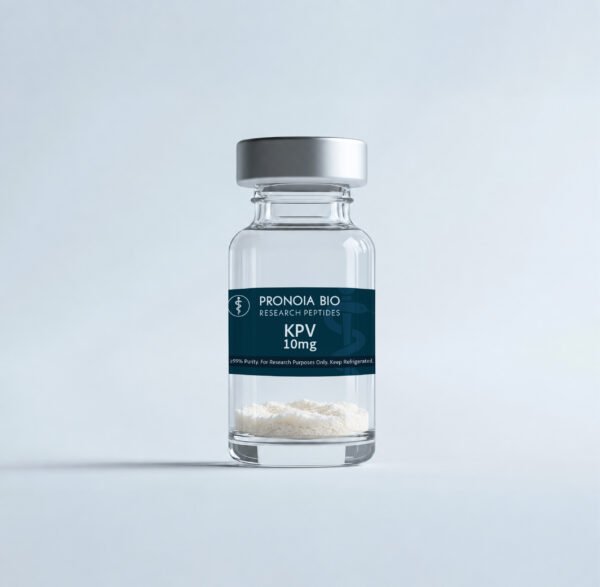
Description
About KPV
KPV is a short three-amino-acid research peptide composed of lysine, proline and valine.
Its sequence represents residues 11–13 of alpha-melanocyte-stimulating hormone (α-MSH), making KPV the C-terminal tripeptide fragment of a larger endogenous melanocortin peptide involved in several signalling systems.
KPV has been investigated particularly in experimental models of inflammatory-response biology.
Published laboratory research has examined how KPV influences signalling pathways that regulate inflammatory gene activity, including NF-κB and mitogen-activated protein kinase (MAPK) pathways.
Researchers have also reported changes in pro-inflammatory cytokine and chemokine output in epithelial and immune-cell systems, together with experimental effects in intestinal inflammatory models.
These findings make KPV relevant to research examining inflammatory signalling, epithelial and immune-cell responses, peptide transport and barrier-associated biology.
Pronoia supplies KPV in a 10mg lyophilised research format with batch traceability and supporting documentation available for the supplied material.
Product Specification
Product: KPV
Strength: 10mg
Peptide class: Synthetic tripeptide / melanocortin-derived peptide
Peptide length: 3 amino acids
Sequence: H-Lys-Pro-Val-OH
Sequence notation: KPV
Parent sequence: α-MSH residues 11–13
Research focus: Inflammatory signalling, cytokine regulation, epithelial and immune-cell biology, and barrier-response models
Form: Lyophilised solid
Pronoia minimum purity standard: ≥99%
Batch traceability: Maintained
SKU: PB-KPV-10
Testing & Batch Documentation
Pronoia maintains a structured quality, testing and traceability process for KPV, with supporting documentation retained for the supplied research material.
- Batch-tested research material
- Pronoia minimum accepted purity standard of ≥99%
- Full batch traceability
- Batch-separated and labelled inventory
- Physical inventory routinely reconciled with digital stock records
- Temperature-controlled cold storage
- Certificate of Analysis (COA) and Safety Data Sheet (SDS) documentation available
The applicable Certificate of Analysis should be treated as the authoritative reference for the identity, purity and analytical results reported for an individual batch.
Research Context
KPV has been investigated primarily as a melanocortin-derived tripeptide in experimental models examining inflammatory signalling and cellular responses to inflammatory stimuli.
Its parent peptide, α-MSH, participates in melanocortin signalling and has been widely investigated in immune and inflammatory biology. KPV represents only the final three amino acids of that larger sequence, allowing researchers to investigate biological activity associated with this compact peptide fragment.
NF-κB and MAPK inflammatory signalling
One important area of KPV research involves NF-κB and MAPK signalling.
NF-κB is a transcriptional signalling system that can regulate the expression of numerous genes involved in cellular inflammatory responses.
MAPK pathways — including ERK, JNK and p38 — form another major group of signalling systems through which cells respond to environmental and inflammatory stimuli.
In cultured intestinal epithelial and immune cells, researchers reported that KPV exposure was associated with:
- Reduced NF-κB activation
- Reduced MAPK pathway activation
- Reduced secretion of pro-inflammatory cytokines
- Changes in cellular inflammatory-response signalling
These findings provide a defined experimental basis for investigating how a three-amino-acid peptide can influence intracellular inflammatory signalling.
PepT1 transport and epithelial-cell research
Research has also investigated how KPV enters particular cells.
Experiments identified the peptide transporter PepT1 as a route through which KPV can be transported into intestinal epithelial and immune cells.
This is scientifically useful because it links peptide uptake with downstream changes in NF-κB, MAPK and cytokine signalling.
KPV has therefore been used in experimental research examining:
- Peptide transport across epithelial-cell systems
- PepT1-mediated cellular uptake
- Intestinal epithelial signalling
- Immune-cell responses
- Barrier-associated inflammatory biology
Preclinical intestinal inflammatory models
KPV has also been investigated in several mouse models of intestinal inflammation.
Under the experimental conditions used, researchers reported reductions in inflammatory changes within colonic tissue together with changes in inflammatory markers and cellular infiltration.
Separate studies using DSS- and TNBS-associated colitis models also reported reduced intestinal inflammatory responses following KPV exposure.
These experiments broadened the KPV research context from isolated cell signalling into integrated epithelial, immune and tissue-level inflammatory models.
Interestingly, experiments using mice with non-functional melanocortin-1 receptor signalling indicated that some KPV-associated effects could still occur.
This suggests that KPV biology should not be interpreted simply as a miniature version of classical α-MSH receptor signalling and has supported investigation of alternative intracellular and transport-dependent mechanisms.
Inflammatory signalling beyond intestinal models
KPV has also been examined in human bronchial epithelial-cell systems.
Under inflammatory stimulation, researchers reported dose-dependent reductions in:
- NF-κB signalling
- IL-8 secretion
- Eotaxin secretion
- Matrix metalloproteinase-9 activity
Mechanistic experiments associated the KPV response with stabilisation of IκBα and reduced nuclear movement of the NF-κB component p65RelA.
These findings extend KPV research beyond intestinal systems and provide additional evidence for investigating intracellular inflammatory signalling within epithelial cells.
Together, the available evidence makes KPV particularly relevant to experimental research examining inflammatory-response pathways, cytokine regulation, epithelial and immune-cell biology, peptide transport and barrier-associated signalling.
The evidence base remains predominantly laboratory and preclinical. Findings from these experimental systems do not establish clinical efficacy, safety or suitability for human or veterinary use.
Storage & Handling
KPV is supplied in lyophilised form and should be stored according to the conditions specified by Pronoia and the applicable batch documentation.
Pronoia stock is maintained in temperature-controlled cold storage and organised by identifiable batch prior to dispatch.
The material should be protected from unnecessary exposure to heat, moisture and light and handled using appropriate laboratory procedures.
Where batch-specific storage or handling information is supplied, that information should take precedence.
UK Delivery
KPV is dispatched from Pronoia’s UK stock using tracked delivery.
Current availability and dispatch information are shown directly on the product page, with tracking supplied following dispatch.
Orders are prepared through Pronoia’s established research-product fulfilment process, with applicable delivery conditions remaining subject to Pronoia’s current delivery terms.
Research Use
KPV supplied by Pronoia Bio is intended for laboratory research and experimental use only.
It is not supplied for human or veterinary use and should not be treated as a medicine or consumer healthcare product.
Pronoia does not provide dosage, treatment or administration guidance for this research material.