Description
About Melanotan 2
Melanotan 2, also known as Melanotan II or MT-II, is a synthetic cyclic seven-amino-acid analogue of alpha-melanocyte-stimulating hormone (α-MSH).
α-MSH belongs to the melanocortin signalling system, a family of peptide signals and receptors involved in biological processes ranging from pigmentation to central regulation of feeding, energy balance and behaviour.
Melanotan 2 was designed as a compact, lactam-cyclised melanocortin analogue with modifications that increase its experimental potency and stability relative to the native α-MSH sequence.
It acts as a broad melanocortin-receptor agonist with activity at MC1R, MC3R, MC4R and MC5R. Because those receptor subtypes are distributed across different tissues and neural systems, Melanotan 2 has been used experimentally to investigate several distinct areas of melanocortin biology.
MC1R-related research has focused strongly on melanocytes, melanin production and pigmentation. MC3R and particularly MC4R are prominent in central signalling involved in energy homeostasis and feeding behaviour, while wider melanocortin research has examined behavioural and neuroendocrine responses.
Early controlled human research also produced measurable changes in pigmentation and helped identify additional centrally mediated biological responses, broadening the scientific interest in Melanotan 2 beyond melanocyte biology alone.
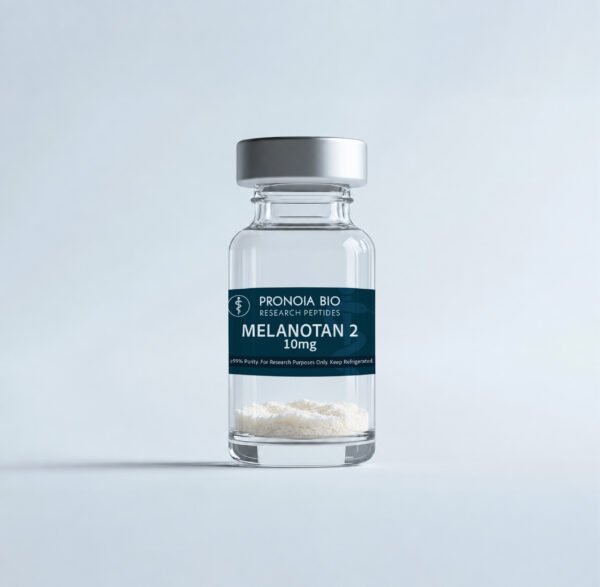
Pronoia supplies Melanotan 2 in a 10mg lyophilised research format with batch traceability and supporting documentation available for the supplied material.
Product Specification
Product: Melanotan 2
Alternative names: Melanotan II / MT-II / MT2
Strength: 10mg
Peptide class: Synthetic cyclic heptapeptide / melanocortin analogue
Peptide length: 7 amino acids
Parent framework: α-MSH-derived peptide
Sequence notation: Ac-Nle-cyclo[Asp-His-D-Phe-Arg-Trp-Lys]-NH₂
Cyclic structure: Asp–Lys lactam bridge
Research targets: MC1R, MC3R, MC4R and MC5R
Research focus: Melanogenesis and pigmentation, energy homeostasis, feeding behaviour and central melanocortin signalling
Form: Lyophilised solid
Pronoia minimum purity standard: ≥99%
Batch traceability: Maintained
SKU: PB-MT2-10
Testing & Batch Documentation
Pronoia maintains a structured quality, testing and traceability process for Melanotan 2, with supporting documentation retained for the supplied research material.
- Batch-tested research material
- Pronoia minimum accepted purity standard of ≥99%
- Full batch traceability
- Batch-separated and labelled inventory
- Physical inventory routinely reconciled with digital stock records
- Temperature-controlled cold storage
- Certificate of Analysis (COA) and Safety Data Sheet (SDS) documentation available
The applicable Certificate of Analysis should be treated as the authoritative reference for the identity, purity and analytical results reported for an individual batch.
Research Context
Melanotan 2 has been used extensively as an experimental probe of melanocortin-receptor biology.
The melanocortin receptor family contains five receptor subtypes. Melanotan 2 acts as a potent but non-selective agonist at MC1R, MC3R, MC4R and MC5R rather than targeting only one receptor.
This broad receptor profile is important because it allows the compound to produce different experimental responses according to the receptor populations and biological systems being studied.
Structure and melanocortin-receptor activity
Melanotan 2 is derived from an active region of α-MSH but incorporates several structural changes.
Its sequence contains norleucine and D-phenylalanine residues together with a cyclic lactam bridge connecting the aspartic-acid and lysine side chains.
The resulting structure is represented as:
Ac-Nle-cyclo[Asp-His-D-Phe-Arg-Trp-Lys]-NH₂
The cyclic design preserves the central His-D-Phe-Arg-Trp melanocortin pharmacophore — the sequence region strongly associated with melanocortin-receptor activation.
These structural characteristics have made Melanotan 2 useful in receptor-binding, signalling and structure–activity studies comparing synthetic melanocortin ligands.
MC1R, melanin production and pigmentation research
MC1R is expressed prominently in melanocytes, the specialised cells responsible for producing melanin pigment.
Activation of MC1R stimulates intracellular signalling involved in melanogenesis — the biological process through which melanin is produced.
Melanotan 2 has therefore been investigated extensively in models examining:
- MC1R activation
- Melanocyte signalling
- Melanin synthesis
- Pigmentation biology
- Melanocortin structure–activity relationships
Early controlled human experimental research also investigated Melanotan 2 as a melanotropic peptide.
In a small phase-I study, researchers reported measurable increases in pigmentation following repeated experimental exposure, assessed using both quantitative reflectance measurements and visual evaluation.
These observations provided direct human evidence that Melanotan 2 could activate pigmentation-related melanocortin biology under the conditions studied.
MC4R, feeding behaviour and energy homeostasis
Melanotan 2 has also become a widely used experimental probe of central melanocortin pathways involved in energy regulation.
The melanocortin-4 receptor, or MC4R, is expressed in several regions of the central nervous system and plays an important role in the regulation of food intake and energy expenditure.
In mouse experiments, Melanotan 2 was reported to:
- Reduce food intake
- Increase metabolic rate
- Produce changes in energy-balance-related behaviour
The role of MC4R was demonstrated particularly clearly using receptor-knockout models.
Wild-type mice responded to Melanotan 2 with increased metabolic rate and reduced food intake, whereas mice lacking functional MC4R were largely insensitive to those acute effects.
These findings provided direct experimental evidence linking Melanotan 2 responses with MC4R-dependent energy-regulation pathways.
Other experimental models have used Melanotan 2 to investigate meal size, hypothalamic signalling and the neural circuits through which melanocortin receptors influence feeding behaviour.
Central melanocortin and behavioural research
The central melanocortin system also participates in behavioural and autonomic processes beyond feeding.
Melanotan 2 has been investigated experimentally in relation to centrally mediated sexual-response pathways.
In early double-blind, placebo-controlled human studies, researchers reported increased erectile responses following Melanotan 2 exposure and, in some participants, increased reported sexual desire.
These studies contributed to subsequent research into the role of central melanocortin receptors — particularly MC4R-associated pathways — in sexual-response signalling.
The same early human studies also reported adverse experimental observations including nausea, yawning and stretching responses.
These findings are relevant to melanocortin pharmacology but should not be interpreted as evidence supporting personal or therapeutic use.
Interpreting a non-selective melanocortin agonist
Because Melanotan 2 activates several receptor subtypes, biological effects observed in an intact experimental system cannot automatically be attributed to one receptor without additional receptor-selective or genetic evidence.
This is one reason why Melanotan 2 has frequently been used alongside receptor antagonists, knockout models and more selective melanocortin ligands.
Its broad activity makes it particularly useful for research examining:
- MC1R-associated melanocyte and pigmentation biology
- MC3R and MC4R signalling
- Feeding and energy-homeostasis pathways
- Central behavioural melanocortin signalling
- Melanocortin receptor pharmacology
- Peptide structure–activity relationships
The evidence includes cell-based, animal and early controlled human experimental research. Findings vary according to receptor expression, tissue, species and study design and do not establish clinical efficacy, safety or suitability for human or veterinary use.
Storage & Handling
Melanotan 2 is supplied in lyophilised form and should be stored according to the conditions specified by Pronoia and the applicable batch documentation.
Pronoia stock is maintained in temperature-controlled cold storage and organised by identifiable batch prior to dispatch.
The material should be protected from unnecessary exposure to heat, moisture and light and handled using appropriate laboratory procedures.
Where batch-specific storage or handling information is supplied, that information should take precedence.
UK Delivery
Melanotan 2 is dispatched from Pronoia’s UK stock using tracked delivery.
Current availability and dispatch information are shown directly on the product page, with tracking supplied following dispatch.
Orders are prepared through Pronoia’s established research-product fulfilment process, with applicable delivery conditions remaining subject to Pronoia’s current delivery terms.
Research Use
Melanotan 2 supplied by Pronoia Bio is intended for laboratory research and experimental use only.
It is not supplied for human or veterinary use and should not be treated as a medicine or consumer healthcare product.
Pronoia does not provide dosage, treatment or administration guidance for this research material.