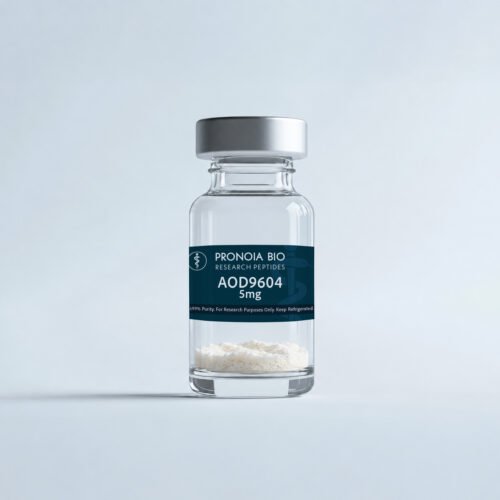

Description
About MOTS-C
MOTS-C is a 16-amino-acid mitochondrial-derived peptide originally identified from a short open reading frame within the mitochondrial 12S ribosomal RNA region.
Its sequence is Met-Arg-Trp-Gln-Glu-Met-Gly-Tyr-Ile-Phe-Tyr-Pro-Arg-Lys-Leu-Arg, commonly represented as MRWQEMGYIFYPRKLR.
Mitochondria are best known for their role in cellular energy production, but they also function as signalling centres that communicate information about metabolic conditions to the rest of the cell. MOTS-C is particularly interesting because it provides an experimental example of a signalling peptide encoded by mitochondrial rather than nuclear DNA.
Published research has linked MOTS-C with cellular energy sensing, glucose metabolism and AMPK — a major signalling system activated when cells experience changes in energy availability.
Research has also shown that MOTS-C can move into the cell nucleus during metabolic stress and influence nuclear gene expression, creating a direct experimental link between mitochondrial signals and the nuclear stress response.
More recent work has expanded the MOTS-C research landscape into skeletal-muscle metabolism, exercise responses, physical-capacity models and mitochondrial bioenergetics.
Together, these characteristics make MOTS-C relevant to experimental studies of metabolic homeostasis, energy-stress adaptation, mitochondria-to-nucleus communication and skeletal-muscle biology.
Pronoia supplies MOTS-C in a 10mg lyophilised research format with batch traceability and supporting documentation available for the supplied material.
Product Specification
Product: MOTS-C
Strength: 10mg
Full name: Mitochondrial Open Reading Frame of the 12S rRNA-c
Peptide class: Mitochondrial-derived peptide
Peptide length: 16 amino acids
Sequence: H-Met-Arg-Trp-Gln-Glu-Met-Gly-Tyr-Ile-Phe-Tyr-Pro-Arg-Lys-Leu-Arg-OH
Sequence notation: MRWQEMGYIFYPRKLR
Biological origin: Mitochondrial DNA-encoded 12S rRNA region
Research pathways: AMPK signalling, metabolic-stress responses and mitonuclear communication
Research focus: Energy sensing, glucose and metabolic regulation, skeletal-muscle biology and mitochondrial signalling
Form: Lyophilised solid
Pronoia minimum purity standard: ≥99%
Batch traceability: Maintained
SKU: PB-MOTS-10
Testing & Batch Documentation
Pronoia maintains a structured quality, testing and traceability process for MOTS-C, with supporting documentation retained for the supplied research material.
- Batch-tested research material
- Pronoia minimum accepted purity standard of ≥99%
- Full batch traceability
- Batch-separated and labelled inventory
- Physical inventory routinely reconciled with digital stock records
- Temperature-controlled cold storage
- Certificate of Analysis (COA) and Safety Data Sheet (SDS) documentation available
The applicable Certificate of Analysis should be treated as the authoritative reference for the identity, purity and analytical results reported for an individual batch.
Research Context
MOTS-C was identified as a mitochondrial-encoded peptide during research examining whether mitochondrial DNA contains short open reading frames capable of producing biologically active signalling molecules.
Its discovery expanded the concept of mitochondria from cellular energy-producing organelles into active participants in cellular communication and metabolic regulation.
AMPK and cellular energy sensing
One of the strongest areas of MOTS-C research concerns AMP-activated protein kinase, or AMPK.
AMPK acts as a cellular energy sensor. When cellular energy availability changes, AMPK can alter metabolic pathways to help restore energy balance.
Foundational MOTS-C research reported that the peptide influenced folate-cycle and de novo purine metabolism, leading to accumulation of the AMP analogue AICAR and subsequent AMPK activation.
Experimental findings included:
- Activation of AMPK-associated metabolic signalling
- Changes in folate and purine metabolic pathways
- Increased glucose utilisation in skeletal-muscle-related experimental systems
- Changes in cellular metabolic homeostasis
These findings provided an important mechanistic connection between a mitochondrial-encoded peptide and cellular energy-sensing pathways.
Glucose regulation and metabolic models
MOTS-C has also been investigated extensively in preclinical metabolic models.
In mice exposed to high-fat-diet conditions, researchers reported changes including:
- Improved glucose handling
- Improved insulin sensitivity
- Reduced development of diet-associated metabolic dysfunction
- Changes in body-weight and metabolic responses under the experimental conditions used
Skeletal muscle was identified as an important target tissue within these experiments.
These findings have made MOTS-C relevant to research examining how mitochondrial signals interact with glucose utilisation, insulin-responsive metabolism and whole-body metabolic homeostasis.
The findings derive primarily from preclinical experimental models and should not be interpreted as established metabolic or weight-management effects in humans.
Mitochondria-to-nucleus signalling
A particularly distinctive area of MOTS-C biology concerns communication between the mitochondrial and nuclear genomes.
Under metabolic stresses including glucose restriction and oxidative stress, researchers reported that MOTS-C could translocate from the cytoplasmic environment into the nucleus.
This nuclear movement was dependent on AMPK signalling.
Within the nucleus, MOTS-C was associated with changes in the expression of genes involved in cellular stress adaptation.
Experimental research reported:
- Stress-induced nuclear translocation of MOTS-C
- AMPK-dependent regulation of this nuclear response
- Changes in stress-responsive nuclear gene expression
- Interaction with transcriptional systems associated with antioxidant-response elements
- Interaction with NRF2-associated stress-response signalling
This makes MOTS-C particularly interesting as a model of mitonuclear communication — signalling in which information originating from mitochondria influences activity within the cell nucleus.
Exercise and skeletal-muscle research
Research has also examined whether endogenous MOTS-C responds to physical activity.
In a study involving healthy young men performing cycling exercise, researchers measured MOTS-C in skeletal muscle and circulation before and after exercise.
Endogenous MOTS-C levels increased substantially in skeletal muscle following exercise and also increased transiently in circulation.
This provided human physiological evidence that the body’s own MOTS-C system responds dynamically to exercise.
The same research programme investigated exogenous MOTS-C in mouse models and reported:
- Improved physical performance across young, middle-aged and older mice
- Changes in skeletal-muscle metabolism
- Changes in nuclear genes involved in metabolism and protein homeostasis
- Improved cellular adaptation to metabolic stress
The human component demonstrated changes in endogenous MOTS-C associated with exercise; the intervention and physical-performance findings were principally derived from mouse and cell models. These evidence types should therefore be distinguished rather than treated as equivalent.
Metabolic-stress and cellular adaptation research
MOTS-C has also been studied in cultured cells exposed to restricted glucose, serum deprivation and oxidative stress.
These experiments have examined how mitochondrial signals help cells adapt when nutrients or energy availability change.
Research has linked MOTS-C with:
- AMPK-dependent stress responses
- NRF2-associated antioxidant-response signalling
- HSF1-associated cellular stress adaptation
- Gene-expression changes during metabolic stress
- Cell survival under nutrient-restricted experimental conditions
This provides a broader research context in which MOTS-C functions not merely as a metabolic peptide but as an experimental regulator of cellular adaptation to changing energetic conditions.
Newer skeletal-muscle mechanisms
More recent research has continued to refine the molecular mechanisms associated with MOTS-C.
Experimental work has identified casein kinase 2 (CK2) as a direct MOTS-C-binding protein and reported that CK2 activity contributed to MOTS-C-associated changes in skeletal-muscle glucose uptake and muscle homeostasis in mouse models.
Further recent research has examined mitochondrial bioenergetic performance in skeletal muscle and reported MOTS-C-associated changes that depended on AMPK and the metabolic transcriptional regulator PGC-1α.
These findings extend the research landscape from broad metabolic effects into more specific questions concerning mitochondrial efficiency, energy sensing and skeletal-muscle signalling.
Together, the current evidence makes MOTS-C particularly relevant to research examining:
- AMPK-linked cellular energy sensing
- Glucose and fuel metabolism
- Skeletal-muscle metabolic regulation
- Mitochondrial-to-nuclear communication
- Metabolic and oxidative-stress responses
- Exercise-associated mitochondrial signalling
- Mitochondrial bioenergetics and cellular adaptation
The evidence base includes cell-culture, animal and human physiological research, but the types of evidence differ considerably. Human studies have demonstrated endogenous MOTS-C responses to processes such as exercise, while many findings involving administration of synthetic MOTS-C derive from laboratory and preclinical models.
These findings do not establish clinical efficacy, safety or suitability for human or veterinary use.
Storage & Handling
MOTS-C is supplied in lyophilised form and should be stored according to the conditions specified by Pronoia and the applicable batch documentation.
Pronoia stock is maintained in temperature-controlled cold storage and organised by identifiable batch prior to dispatch.
The material should be protected from unnecessary exposure to heat, moisture and light and handled using appropriate laboratory procedures.
Where batch-specific storage or handling information is supplied, that information should take precedence.
UK Delivery
MOTS-C is dispatched from Pronoia’s UK stock using tracked delivery.
Current availability and dispatch information are shown directly on the product page, with tracking supplied following dispatch.
Orders are prepared through Pronoia’s established research-product fulfilment process, with applicable delivery conditions remaining subject to Pronoia’s current delivery terms.
Research Use
MOTS-C supplied by Pronoia Bio is intended for laboratory research and experimental use only.
It is not supplied for human or veterinary use and should not be treated as a medicine or consumer healthcare product.
Pronoia does not provide dosage, treatment or administration guidance for this research material.