Description
About SNAP-8
SNAP-8, also known as Acetyl Octapeptide-3, is a synthetic eight-amino-acid peptide with the sequence Ac-Glu-Glu-Met-Gln-Arg-Arg-Ala-Asp-NH₂.
The peptide is modified at both termini, with N-terminal acetylation and C-terminal amidation, giving the abbreviated structural notation Ac-EEMQRRAD-NH₂.
SNAP-8 was developed within the neurocosmetic peptide field as an extended analogue of Acetyl Hexapeptide-8. The additional alanine and aspartic-acid residues create an eight-amino-acid sequence derived from the same structural research concept.
This peptide family was designed around the biology of SNAP-25, a protein that participates with syntaxin and synaptobrevin in formation of the SNARE complex responsible for regulated vesicle fusion and neurotransmitter release.
SNAP-8 is therefore used as an experimental research material for investigating SNAP-25 / SNARE-associated signalling, regulated exocytosis, peptide structure–function relationships and neurocosmetic cellular models.
The direct independent evidence base for Acetyl Octapeptide-3 itself remains limited, so findings involving related SNAP-25-derived peptides, manufacturer experiments or multi-ingredient formulations should not automatically be treated as direct results for SNAP-8 alone.
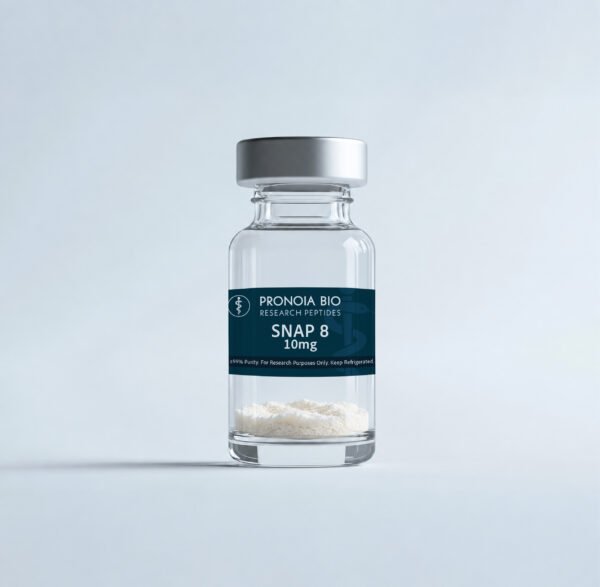
Pronoia supplies SNAP-8 in a 10mg lyophilised research format with batch traceability and supporting documentation available for the supplied material.
Product Specification
Product: SNAP-8
Alternative name: Acetyl Octapeptide-3
Strength: 10mg
Peptide class: Synthetic acetylated octapeptide
Peptide length: 8 amino acids
Sequence: Ac-Glu-Glu-Met-Gln-Arg-Arg-Ala-Asp-NH₂
Sequence notation: Ac-EEMQRRAD-NH₂
N-terminal modification: Acetylated
C-terminal modification: Amidated
Structural relation: Extended analogue of Acetyl Hexapeptide-8
Research system: SNAP-25 / SNARE-complex-associated signalling
Research focus: Vesicle fusion, regulated exocytosis, neurotransmitter-release models and neurocosmetic signalling
Form: Lyophilised solid
Pronoia minimum purity standard: ≥99%
Batch traceability: Maintained
SKU: PB-SNAP8-10
Testing & Batch Documentation
Pronoia maintains a structured quality, testing and traceability process for SNAP-8, with supporting documentation retained for the supplied research material.
- Batch-tested research material
- Pronoia minimum accepted purity standard of ≥99%
- Full batch traceability
- Batch-separated and labelled inventory
- Physical inventory routinely reconciled with digital stock records
- Temperature-controlled cold storage
- Certificate of Analysis (COA) and Safety Data Sheet (SDS) documentation available
The applicable Certificate of Analysis should be treated as the authoritative reference for the chemical identity, purity and analytical results reported for an individual batch.
Research Context
SNAP-8 is investigated primarily within peptide structure–function and neurocosmetic research centred on regulated vesicle fusion and neurotransmitter-release machinery.
Understanding this research requires distinguishing between the well-established biology of the SNARE system, research involving SNAP-25-derived peptides more broadly, and the more limited direct evidence available specifically for Acetyl Octapeptide-3.
SNAP-25 and the SNARE complex
Regulated neurotransmitter release depends on fusion between intracellular vesicles and the cellular plasma membrane.
A central molecular component of this process is the SNARE complex.
In neuronal and neuroendocrine systems, the core complex is formed principally from:
- SNAP-25
- Syntaxin-1
- Synaptobrevin / VAMP
Assembly of these proteins creates a tightly organised molecular complex that helps bring vesicle and cellular membranes together.
Calcium-dependent signalling can then trigger membrane fusion and release of vesicle contents into the extracellular environment.
SNARE biology is therefore central to experimental research involving:
- Synaptic vesicle fusion
- Regulated exocytosis
- Neurotransmitter release
- Neuroendocrine secretion
- Protein–protein interactions within membrane-fusion machinery
SNAP-25-derived peptide research
SNAP-25 contributes two helical domains to the neuronal SNARE complex and interacts directly with syntaxin and synaptobrevin.
Researchers have investigated whether short peptide sequences derived from regions of SNAP-25 can interfere with formation of this protein complex.
Published laboratory research involving SNAP-25-derived peptides has demonstrated that selected N-terminal-derived sequences can inhibit SNARE-complex formation and reduce calcium-dependent exocytosis in experimental neuronal and excitable-cell systems.
These experiments provide important support for the broader concept that short peptides patterned after SNAP-25 can be used to investigate SNARE assembly and regulated secretion.
However, the specific peptide sequences examined in this independent research should not automatically be treated as identical to SNAP-8.
Structure of SNAP-8
SNAP-8 has the defined structure:
Ac-Glu-Glu-Met-Gln-Arg-Arg-Ala-Asp-NH₂
or:
Ac-EEMQRRAD-NH₂
It is structurally related to Acetyl Hexapeptide-8, commonly known as Argireline, which contains the shorter sequence:
Ac-Glu-Glu-Met-Gln-Arg-Arg-NH₂
SNAP-8 extends this six-residue sequence by adding alanine and aspartic acid at the C-terminus.
This makes the pair useful from a structure–function perspective when examining how changes in peptide length and terminal sequence influence proposed interactions with protein systems involved in regulated exocytosis.
Proposed SNARE-complex modulation
SNAP-8 was developed around the hypothesis that a peptide based on SNAP-25-associated sequence features could interfere competitively with formation of the functional SNARE complex.
Under this proposed model, altered SNARE assembly would influence vesicle fusion and consequently modify release of signalling molecules from secretory cells.
A peer-reviewed review of cosmeceutical peptides has described in-vitro SNAP-8 results involving SNARE-complex modulation and neurotransmitter-related release.
Importantly, those numerical results were traced to manufacturer research rather than to an independently published standalone SNAP-8 study.
For this reason, Pronoia describes SNARE modulation as the principal experimental research rationale surrounding SNAP-8 rather than presenting a fixed degree of inhibition as an independently established property of every SNAP-8 preparation.
Regulated exocytosis and neurotransmitter research
The biological pathway underlying the SNAP-8 research concept is regulated exocytosis.
In neuronal systems, neurotransmitters are packaged within intracellular vesicles.
For release to occur, these vesicles must dock with and fuse to the presynaptic membrane.
SNARE-complex formation is a critical component of this process.
Research surrounding SNAP-8 and related peptide systems therefore examines:
- SNARE-complex assembly
- SNAP-25 / syntaxin interactions
- Vesicle docking and membrane fusion
- Calcium-dependent exocytosis
- Neurotransmitter and catecholamine release models
These pathways provide a considerably more precise description of SNAP-8 research than the broader term “cellular signalling”.
Neurocosmetic and skin-model research
SNAP-8 is most commonly associated commercially with neurocosmetic research.
Neurocosmetic research examines interactions between skin biology, peripheral signalling and molecular pathways associated with neuromuscular communication.
The proposed SNAP-8 mechanism has generated particular interest in models examining signalling associated with repetitive facial-muscle activity and expression-line formation.
However, evidence from a signalling model should not be interpreted automatically as evidence of a measurable cosmetic effect.
Human studies in which Acetyl Octapeptide-3 has appeared have generally evaluated multi-component cosmetic formulations rather than purified SNAP-8 as an isolated experimental variable.
For example, published microneedle studies have included Acetyl Octapeptide-3 alongside hyaluronic acid and other bioactive ingredients and have reported changes in wrinkle-related skin measurements.
Because several active components and specialised delivery systems were used simultaneously, those studies cannot establish which outcomes were caused specifically by Acetyl Octapeptide-3.
Relationship with botulinum-toxin research
SNAP-8 and related cosmetic peptides are sometimes described commercially using terms such as “Botox-like”.
That comparison is scientifically imprecise.
Botulinum neurotoxins are large bacterial proteins that enzymatically cleave components of the neurotransmitter-release machinery.
SNAP-8 is a short synthetic peptide associated with a proposed competitive modulation of SNARE-complex assembly.
The molecules, mechanisms, potency, delivery characteristics and evidence bases are fundamentally different.
Pronoia therefore does not describe SNAP-8 as an alternative or equivalent to botulinum toxin.
Interpreting the SNAP-8 evidence base
SNAP-8 has a clear molecular identity and a scientifically plausible research rationale based on the established biology of SNAP-25 and SNARE-mediated vesicle fusion.
The most appropriate experimental research areas include:
- SNAP-25 and SNARE-complex biology
- Peptide–protein structure–function research
- Regulated vesicle exocytosis
- Neurotransmitter-release models
- Neurocosmetic signalling research
- Comparative research involving short SNAP-25-inspired peptide sequences
The direct independent peer-reviewed literature specifically testing purified Acetyl Octapeptide-3 remains limited.
Results from manufacturer experiments, related SNAP-25-derived peptides and multi-ingredient cosmetic formulations should therefore be distinguished from direct standalone evidence for SNAP-8.
The available evidence does not establish therapeutic effects, systemic neuromuscular effects or suitability for human or veterinary use.
Storage & Handling
SNAP-8 is supplied in lyophilised form and should be stored according to the conditions specified by Pronoia and the applicable batch documentation.
Pronoia stock is maintained in temperature-controlled cold storage and organised by identifiable batch prior to dispatch.
The material should be protected from unnecessary exposure to heat, moisture and light and handled using appropriate laboratory procedures.
Where batch-specific storage or handling information is supplied, that information should take precedence.
UK Delivery
SNAP-8 is dispatched from Pronoia’s UK stock using tracked delivery.
Current availability and dispatch information are shown directly on the product page, with tracking supplied following dispatch.
Orders are prepared through Pronoia’s established research-product fulfilment process, with applicable delivery conditions remaining subject to Pronoia’s current delivery terms.
Research Use
SNAP-8 supplied by Pronoia Bio is intended for laboratory research and experimental use only.
It is not supplied for human or veterinary use and should not be treated as a medicine, injectable material, finished cosmetic treatment or consumer skincare product.
Pronoia does not provide dosage, treatment or administration guidance for this research material.