Description
About BPC & TB Blend
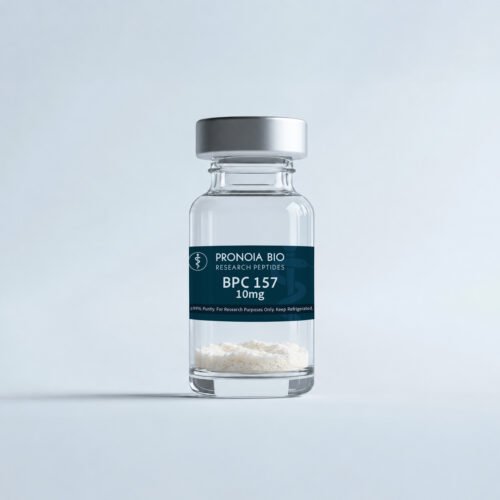
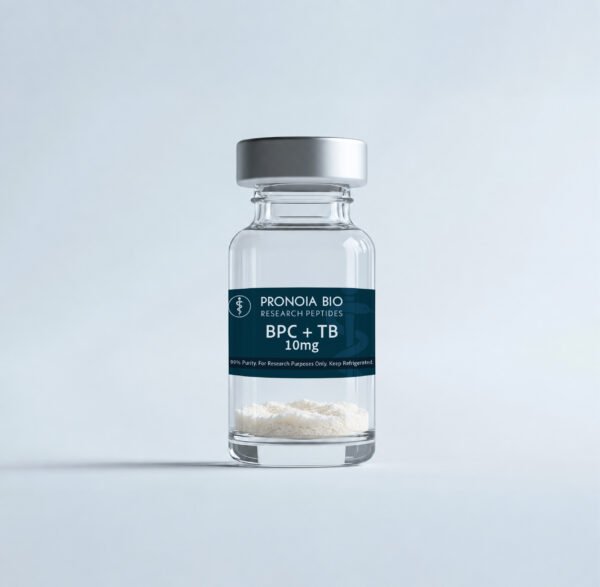
BPC & TB Blend combines BPC-157 and TB-500 in a single lyophilised research preparation. This 10mg format contains 5mg of each peptide, providing a balanced 1:1 blend and a total peptide content of 10mg.
The two components are associated with distinct but related areas of experimental research. BPC-157 has been investigated in tendon-derived fibroblast models examining how these connective-tissue cells migrate, spread and interact with their surroundings.
TB-500-related research centres on a short region associated with thymosin beta-4 and its actin-binding biology. Actin forms part of the cytoskeleton — the internal structural system that allows cells to maintain shape, reorganise and move.
These research areas make the combined preparation relevant to laboratory studies examining cell migration, adhesion, fibroblast behaviour, connective-tissue biology and structural processes associated with tissue repair.
Pronoia supplies the 10mg BPC & TB Blend as a balanced dual-component research preparation with batch traceability and supporting documentation available for the supplied material.
Product Specification
Product: BPC & TB Blend
BPC-157 content: 5mg
TB-500 content: 5mg
Total peptide content: 10mg
Blend ratio: 1:1
Research focus: Cell migration, fibroblast behaviour, connective-tissue and cytoskeletal research
Form: Lyophilised peptide blend
Pronoia minimum purity standard: ≥99%
Batch traceability: Maintained
SKU: PB-BPCTB-10
Testing & Batch Documentation
Pronoia maintains a structured quality, testing and traceability process for BPC & TB Blend, with supporting documentation retained for the supplied research material.
- Batch-tested research material
- Pronoia minimum accepted purity standard of ≥99%
- Full batch traceability
- Batch-separated and labelled inventory
- Physical inventory routinely reconciled with digital stock records
- Temperature-controlled cold storage
- Certificate of Analysis (COA) and Safety Data Sheet (SDS) documentation available
The applicable Certificate of Analysis should be treated as the authoritative reference for the identity and analytical results reported for an individual batch.
Research Context
BPC-157 and TB-500 are investigated as distinct peptide research materials. Findings reported for either component should therefore be considered separately rather than assuming that the combined blend has itself produced the same experimental results.
Published BPC-157 research has included laboratory studies using tendon-derived fibroblasts — cells involved in producing and maintaining connective-tissue structure.
Under the experimental conditions used, researchers reported:
- Increased migration of tendon-derived fibroblasts
- Increased spreading of fibroblasts in cell culture
- Increased cell survival under experimentally induced oxidative stress
- Increased F-actin formation, associated with changes in cellular structure and movement
- Increased activation of FAK and paxillin, signalling proteins involved in cell adhesion and migration
TB-500 requires a separate evidence distinction. Published analytical work examining material described as TB-500 identified an N-terminally acetylated 17–23 fragment of thymosin beta-4, represented by the sequence Ac-LKKTETQ.
This sequence corresponds to the central actin-binding region of thymosin beta-4. Actin is a major component of the cytoskeleton and plays an important role in cell shape, adhesion and movement.
Experimental research involving the thymosin-beta-4 17–23 actin-binding region has examined:
- Actin-related cellular organisation
- Cell adhesion and migration
- Endothelial-cell migration, involving cells that line blood vessels
- Endothelial tube formation
- Vessel-sprouting and angiogenesis-related experimental models
A substantial part of the wider biological literature associated with TB-500 concerns full-length thymosin beta-4 rather than the shorter fragment itself. Findings involving the full-length parent peptide should therefore not automatically be interpreted as direct experimental results for TB-500.
Together, the BPC-157 and TB-500-related research areas make this 1:1 preparation relevant to experimental systems examining how fibroblast behaviour, cellular adhesion, migration, connective-tissue biology and cytoskeletal organisation interact within tissue-repair-related research.
The Pronoia formulation provides both peptide components in a single balanced preparation without implying that findings reported for either component individually have been demonstrated for the combined blend itself.
These findings describe specific laboratory and preclinical research contexts and do not establish suitability for human or veterinary use.
Storage & Handling
BPC & TB Blend is supplied in lyophilised form and should be stored according to the conditions specified by Pronoia and the applicable batch documentation.
Pronoia stock is maintained in temperature-controlled cold storage and organised by identifiable batch prior to dispatch.
The material should be protected from unnecessary exposure to heat, moisture and light and handled using appropriate laboratory procedures.
Where batch-specific storage or handling information is supplied, that information should take precedence.
UK Delivery
BPC & TB Blend is dispatched from Pronoia’s UK stock using tracked delivery.
Current availability and dispatch information are shown directly on the product page, with tracking supplied following dispatch.
Orders are prepared through Pronoia’s established research-product fulfilment process, with applicable delivery conditions remaining subject to Pronoia’s current delivery terms.
Research Use
BPC & TB Blend supplied by Pronoia Bio is intended for laboratory research and experimental use only.
It is not supplied for human or veterinary use and should not be treated as a medicine or consumer healthcare product.
Pronoia does not provide dosage, treatment or administration guidance for this research material.