Description
About IGF-1 LR3
IGF-1 LR3, also known as Long R3 IGF-I, is a modified analogue of insulin-like growth factor 1 (IGF-1), a growth-factor signalling molecule involved in regulating cellular growth, survival, differentiation and metabolism.
Native human IGF-1 contains 70 amino acids. IGF-1 LR3 contains 83 amino acids and incorporates two important structural modifications: replacement of glutamic acid with arginine at position 3 and the addition of a 13-amino-acid extension at the N-terminus.
These modifications substantially reduce the analogue’s affinity for insulin-like growth factor-binding proteins (IGFBPs). IGFBPs normally bind IGF molecules and can strongly influence how much growth factor remains available to interact with cellular receptors.
IGF-1 LR3 nevertheless retains activity at the type 1 IGF receptor (IGF-1R). This combination — preserved receptor activity with greatly reduced IGFBP interaction — has made it particularly useful in experimental systems examining growth-factor signalling, receptor activation and the regulation of cellular proliferation and differentiation.
Published studies have used Long R3 IGF-I in fibroblast, myogenic and other cell models to investigate how IGF-binding proteins influence growth-factor availability and cellular responses.
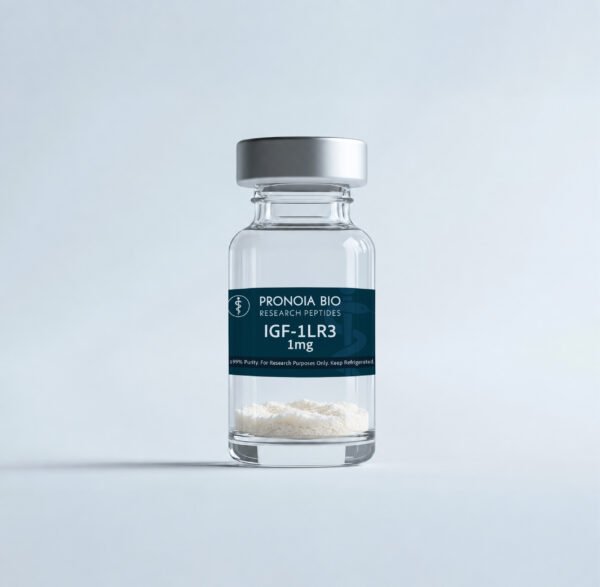
Pronoia supplies IGF-1 LR3 in a 1mg lyophilised research format with batch traceability and supporting documentation available for the supplied material.
Product Specification
Product: IGF-1 LR3
Alternative names: Long R3 IGF-I / LR3 IGF-1
Strength: 1mg
Material class: Modified insulin-like growth factor analogue
Parent molecule: Insulin-like growth factor 1 (IGF-1)
Peptide length: 83 amino acids
Position-3 modification: Glutamic acid replaced by arginine (Arg³)
N-terminal modification: 13-amino-acid extension
Research target: IGF-1 receptor (IGF-1R)
Research characteristic: Greatly reduced IGF-binding-protein affinity while retaining IGF-1R activity
Research focus: Cell proliferation, survival and differentiation, IGF-1R signalling and IGF-binding-protein interactions
Form: Lyophilised solid
Pronoia minimum purity standard: ≥99%
Batch traceability: Maintained
SKU: PB-IGF1LR3-1
Testing & Batch Documentation
Pronoia maintains a structured quality, testing and traceability process for IGF-1 LR3, with supporting documentation retained for the supplied research material.
- Batch-tested research material
- Pronoia minimum accepted purity standard of ≥99%
- Full batch traceability
- Batch-separated and labelled inventory
- Physical inventory routinely reconciled with digital stock records
- Temperature-controlled cold storage
- Certificate of Analysis (COA) and Safety Data Sheet (SDS) documentation available
The applicable Certificate of Analysis should be treated as the authoritative reference for the identity, purity and analytical results reported for an individual batch.
Research Context
IGF-1 LR3 was developed as an analogue of IGF-1 with altered interactions with insulin-like growth factor-binding proteins while preserving biological activity at the IGF-1 receptor.
IGF-1R is a cell-surface receptor involved in signalling pathways that regulate cellular proliferation, survival, differentiation and metabolic activity.
Native IGF-1 activity is strongly influenced by a family of IGF-binding proteins. These proteins can bind IGF molecules in extracellular environments and alter their availability for receptor interaction.
IGF-1 LR3 incorporates two major modifications relative to native IGF-1:
- An arginine residue replaces glutamic acid at position 3
- A 13-amino-acid extension is added to the N-terminus
Together, these changes greatly reduce binding to IGFBPs while preserving activity at the type 1 IGF receptor.
This makes IGF-1 LR3 particularly useful in experiments designed to separate direct IGF-receptor signalling from the regulatory influence of IGF-binding proteins.
Cell proliferation research
Long R3 IGF-I has been used in several cell systems examining proliferative responses.
In postnatal lung fibroblast cultures, researchers reported that both native IGF-I and Long R3 IGF-I increased cell number.
Under the conditions studied, Long R3 IGF-I produced half-maximal stimulation at a lower concentration than native IGF-I, supporting the hypothesis that endogenous IGF-binding proteins within the culture environment were limiting native IGF-I activity.
The experiment demonstrated how reduced IGFBP interaction can alter the apparent potency of an IGF analogue within a defined cellular system.
Myogenic-cell proliferation and differentiation
IGF signalling is also widely investigated in muscle-cell development.
Long R3 IGF-I has been used in embryonic myoblast and established myogenic-cell models examining:
- Myogenic-cell proliferation
- Cell differentiation
- Interactions between IGF signalling and IGFBP-3
- Interactions between IGF signalling and IGFBP-5
These studies have shown that the effects of IGF-binding proteins can differ according to cell type and biological process.
For example, experimental IGFBP-3 could suppress Long R3 IGF-I-stimulated proliferation in some myogenic systems while having different effects on differentiation.
This illustrates an important feature of IGF biology: reduced binding-protein affinity does not make every cellular response universally stronger. The outcome depends on the specific binding protein, cell type, receptor environment and experimental design.
Cell survival and signalling research
IGF-1 LR3 has also been used in experimental systems examining cell-survival signalling.
In IGF-responsive cultured cells, Long R3 IGF-I has been investigated in relation to apoptosis — programmed cell death — allowing researchers to examine how IGF-1 receptor signalling interacts with survival pathways and the regulatory effects of IGF-binding proteins.
Research involving IGF-I and Long R3 IGF-I has also examined intracellular pathways including Akt-associated signalling.
Akt is one of the major downstream signalling systems connected with IGF-1 receptor activation and is involved in processes including cell survival, metabolism and growth-related signalling.
Experimental findings with Long R3 IGF-I have therefore contributed to research involving:
- IGF-1 receptor activation
- Cell proliferation and cell-cycle responses
- Cell survival and apoptosis regulation
- Myogenic differentiation
- Akt-associated intracellular signalling
- IGF-binding-protein regulation
- Growth-factor bioavailability within cell culture systems
Why the LR3 modification matters
The principal research advantage of the LR3 structure is not simply that it is a “stronger IGF-1”.
Its value lies in the way its modified structure changes the normal relationship between an IGF ligand and IGF-binding proteins.
Because Long R3 IGF-I interacts far less strongly with many IGFBPs while remaining active at IGF-1R, researchers can use it to investigate how binding proteins influence growth-factor signalling within different biological environments.
This property has also made Long R3 IGF-I useful as a growth-factor reagent in mammalian cell-culture research.
The biological response remains highly dependent on the experimental system. Animal research has demonstrated that Long R3 IGF-I can produce markedly different outcomes across species and tissues, so findings from individual cell or animal models should not be generalised automatically.
The available research does not establish clinical efficacy, safety or suitability for human or veterinary use.
Storage & Handling
IGF-1 LR3 is supplied in lyophilised form and should be stored according to the conditions specified by Pronoia and the applicable batch documentation.
Pronoia stock is maintained in temperature-controlled cold storage and organised by identifiable batch prior to dispatch.
The material should be protected from unnecessary exposure to heat, moisture and light and handled using appropriate laboratory procedures.
Where batch-specific storage or handling information is supplied, that information should take precedence.
UK Delivery
IGF-1 LR3 is dispatched from Pronoia’s UK stock using tracked delivery.
Current availability and dispatch information are shown directly on the product page, with tracking supplied following dispatch.
Orders are prepared through Pronoia’s established research-product fulfilment process, with applicable delivery conditions remaining subject to Pronoia’s current delivery terms.
Research Use
IGF-1 LR3 supplied by Pronoia Bio is intended for laboratory research and experimental use only.
It is not supplied for human or veterinary use and should not be treated as a medicine or consumer healthcare product.
Pronoia does not provide dosage, treatment or administration guidance for this research material.