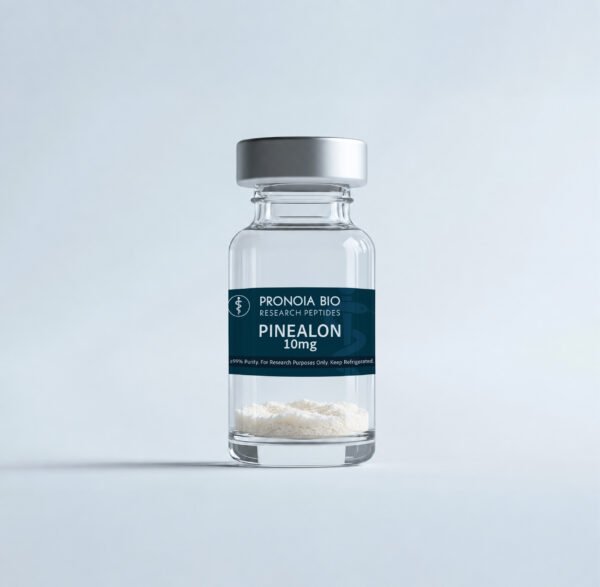
Description
About Pinealon
Pinealon is a short synthetic tripeptide composed of glutamic acid, aspartic acid and arginine, giving the defined sequence Glu-Asp-Arg and the abbreviation EDR.
Its compact three-amino-acid structure has been investigated within the short-peptide bioregulator research field, particularly in experimental systems involving neural-cell stress responses, oxidative biology and regulation of cellular activity.
Published laboratory studies have examined Pinealon in neuronal and other cell models exposed to experimentally induced oxidative stress. Reported findings have included changes in reactive oxygen species, cell viability, ERK-associated signalling and cell-cycle behaviour.
Separate research has investigated how the EDR peptide interacts directly with DNA and how this interaction may contribute to proposed effects on gene and protein regulation.
Pinealon has also been studied in neural-cell models examining serotonin expression and in preclinical models involving hypoxic and metabolic stress.
Together, these areas make Pinealon relevant to experimental research examining how a very short peptide may influence cellular stress responses, neuronal biology and molecular regulatory processes.
Pronoia supplies Pinealon in a 10mg lyophilised research format with batch traceability and supporting documentation available for the supplied material.
Product Specification
Product: Pinealon
Alternative name: EDR peptide
Strength: 10mg
Peptide class: Synthetic tripeptide
Peptide length: 3 amino acids
Sequence: H-Glu-Asp-Arg-OH
Sequence notation: EDR
Research focus: Neural-cell stress responses, oxidative-stress biology, cell viability, gene regulation and peptide–DNA interactions
Form: Lyophilised solid
Pronoia minimum purity standard: ≥99%
Batch traceability: Maintained
SKU: PB-PIN10-10
Testing & Batch Documentation
Pronoia maintains a structured quality, testing and traceability process for Pinealon, with supporting documentation retained for the supplied research material.
- Batch-tested research material
- Pronoia minimum accepted purity standard of ≥99%
- Full batch traceability
- Batch-separated and labelled inventory
- Physical inventory routinely reconciled with digital stock records
- Temperature-controlled cold storage
- Certificate of Analysis (COA) and Safety Data Sheet (SDS) documentation available
The applicable Certificate of Analysis should be treated as the authoritative reference for the identity, purity and analytical results reported for an individual batch.
Research Context
Pinealon, or Glu-Asp-Arg (EDR), has been investigated primarily in cellular and preclinical research examining neural-cell biology, oxidative stress and molecular regulation.
Its research interest comes partly from its unusually compact structure: EDR contains only three amino-acid residues, making it useful for investigating how very short peptide sequences interact with cellular and molecular systems.
Oxidative-stress and cell-viability research
One of the better characterised experimental areas involves cellular responses to oxidative stress.
Published research examined Pinealon in cerebellar granule cells, PC12 cells and other cellular systems exposed to experimentally induced oxidative stress.
Under the conditions studied, researchers reported:
- Reduced accumulation of reactive oxygen species (ROS)
- Reduced necrotic cell death
- Changes in ERK1/2 signalling dynamics
- Changes in cell-cycle behaviour
The relationship between these effects was concentration dependent.
Researchers observed that changes in ROS accumulation and cell mortality reached saturation at lower concentrations than some of the cell-cycle effects, suggesting that Pinealon may influence more than one cellular regulatory mechanism.
These findings make EDR relevant to experimental studies examining oxidative-stress responses, cellular viability and stress-associated signalling.
Neural and hypoxic-stress models
Pinealon has also been investigated in preclinical models involving reduced oxygen availability and neural stress.
In rat studies involving hypoxic conditions, researchers examined changes in neuronal resistance, oxidative processes and endogenous antioxidant systems.
Reported research areas have included:
- Neuronal responses to hypoxic stress
- Reactive oxygen species regulation
- Superoxide-dismutase and glutathione-peroxidase-associated systems
- Cell death and neuronal viability
- Neurochemical responses to experimentally induced stress
Separate experiments involving prenatal hyperhomocysteinaemia in rats reported changes in oxidative-stress markers and neuronal-cell survival together with behavioural measures in the offspring.
These findings derive from specific animal models and should not be interpreted as established neurological effects in humans.
Peptide–DNA interaction research
A particularly distinctive area of Pinealon research concerns direct interaction between the EDR peptide and DNA.
Biophysical experiments using spectroscopy, nuclear magnetic resonance, viscosimetry and molecular-dynamics methods investigated how Glu-Asp-Arg interacts with DNA.
Researchers reported that EDR could partially enter the major groove of the DNA structure and interact with particular atomic sites associated predominantly with guanine bases.
The same research found that divalent magnesium ions could influence the interaction by screening negatively charged DNA phosphate groups.
This provides physical evidence that EDR can interact directly with DNA under defined experimental conditions.
However, demonstrating peptide–DNA interaction in a controlled biochemical system does not by itself prove that a specific gene-regulatory effect will occur within an intact organism.
Gene and protein regulation
Pinealon research has also explored the hypothesis that short peptides can influence gene expression and protein synthesis.
Published work has examined relationships between EDR and proteins or signalling systems associated with:
- Cellular stress responses
- Apoptosis-associated regulation
- Antioxidant enzyme systems
- MAPK / ERK signalling
- Neuronal functional activity
A later review of the EDR research literature proposed potential interactions involving histones, nucleic acids and transcriptional regulation.
These mechanisms remain an active research area and should be regarded as proposed or experimental rather than as a fully established mechanism of action.
Serotonin-related neural-cell research
EDR has also been studied in ageing cultures of cerebral-cortex cells.
Researchers reported increased serotonin expression following exposure to Glu-Asp-Arg and investigated potential regulation of the gene encoding tryptophan hydroxylase, an enzyme involved in serotonin synthesis.
Molecular-docking approaches were used alongside the cellular experiments to explore possible interactions between short peptides and specific nucleotide sequences.
This provides another experimental context in which Pinealon has been studied in relation to neuronal signalling and gene-expression regulation.
Interpreting the Pinealon evidence base
The Pinealon literature is relatively specialised compared with more extensively characterised peptide and receptor systems.
Much of the published evidence consists of cell-culture, biochemical and animal studies, and several proposed molecular mechanisms remain incompletely established.
This makes Pinealon particularly useful as an experimental research material for investigating hypotheses surrounding short-peptide regulation, neural-cell stress biology and peptide–DNA interactions, but findings should not be interpreted as established therapeutic, cognitive-enhancement or anti-ageing effects.
The available evidence does not establish clinical efficacy, safety or suitability for human or veterinary use.
Storage & Handling
Pinealon is supplied in lyophilised form and should be stored according to the conditions specified by Pronoia and the applicable batch documentation.
Pronoia stock is maintained in temperature-controlled cold storage and organised by identifiable batch prior to dispatch.
The material should be protected from unnecessary exposure to heat, moisture and light and handled using appropriate laboratory procedures.
Where batch-specific storage or handling information is supplied, that information should take precedence.
UK Delivery
Pinealon is dispatched from Pronoia’s UK stock using tracked delivery.
Current availability and dispatch information are shown directly on the product page, with tracking supplied following dispatch.
Orders are prepared through Pronoia’s established research-product fulfilment process, with applicable delivery conditions remaining subject to Pronoia’s current delivery terms.
Research Use
Pinealon supplied by Pronoia Bio is intended for laboratory research and experimental use only.
It is not supplied for human or veterinary use and should not be treated as a medicine, cognitive-enhancement product or consumer healthcare product.
Pronoia does not provide dosage, treatment or administration guidance for this research material.