Description
About Sermorelin Acetate
Sermorelin is a synthetic 29-amino-acid research peptide corresponding to the biologically active N-terminal region of human growth hormone-releasing hormone (GHRH).
It is commonly designated GHRH(1–29)-NH₂ and has the sequence Tyr-Ala-Asp-Ala-Ile-Phe-Thr-Asn-Ser-Tyr-Arg-Lys-Val-Leu-Gly-Gln-Leu-Ser-Ala-Arg-Lys-Leu-Leu-Gln-Asp-Ile-Met-Ser-Arg-NH₂.
The Pronoia material is supplied as Sermorelin Acetate, the acetate salt form of this defined peptide.
GHRH is a hypothalamic signalling peptide that regulates growth-hormone-producing cells, known as somatotrophs, within the anterior pituitary.
Sermorelin retains the receptor-active GHRH(1–29) sequence and has therefore been investigated extensively as a research model for growth hormone-releasing hormone receptor (GHRH-R) activation, pituitary signalling and endogenous growth-hormone secretion.
GHRH-R activation initiates intracellular pathways involving cyclic AMP (cAMP), protein kinase A (PKA), CREB-associated transcriptional signalling and changes in intracellular calcium. Together these mechanisms contribute to both growth-hormone synthesis and release from pituitary somatotroph cells.
This makes Sermorelin particularly relevant to research examining the physiological regulation of the growth-hormone axis rather than simply supplying growth hormone directly to an experimental system.
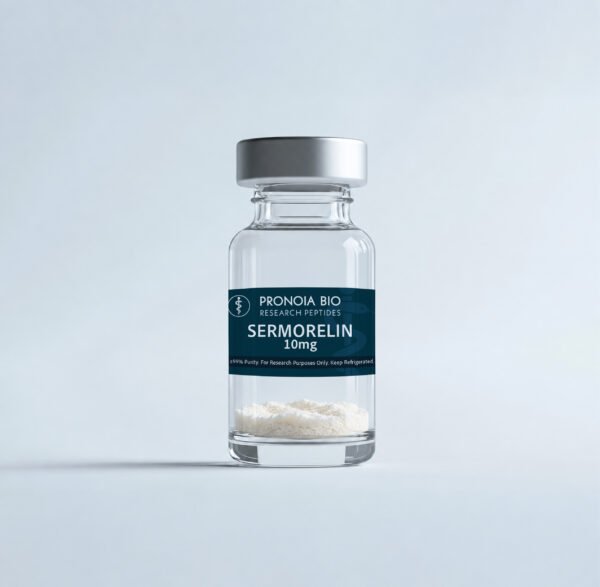
Pronoia supplies Sermorelin Acetate in a 10mg lyophilised research format with batch traceability and supporting documentation available for the supplied material.
Product Specification
Product: Sermorelin Acetate
Strength: 10mg
Alternative designation: GHRH(1–29)-NH₂
Peptide class: Synthetic GHRH peptide fragment
Peptide length: 29 amino acids
Sequence: H-Tyr-Ala-Asp-Ala-Ile-Phe-Thr-Asn-Ser-Tyr-Arg-Lys-Val-Leu-Gly-Gln-Leu-Ser-Ala-Arg-Lys-Leu-Leu-Gln-Asp-Ile-Met-Ser-Arg-NH₂
Sequence notation: YADAIFTNSYRKVLGQLSARKLLQDIMSR-NH₂
Supplied form: Sermorelin acetate
Parent framework: Human growth hormone-releasing hormone (GHRH)
Primary research target: Growth hormone-releasing hormone receptor (GHRH-R)
Research pathways: Gs / adenylyl cyclase / cAMP / PKA / CREB signalling and calcium-dependent secretion
Research focus: Pituitary somatotroph signalling, endogenous GH synthesis and release, GHRH receptor biology and endocrine feedback
Form: Lyophilised solid
Pronoia minimum purity standard: ≥99%
Batch traceability: Maintained
SKU: PB-SERM-10
Testing & Batch Documentation
Pronoia maintains a structured quality, testing and traceability process for Sermorelin Acetate, with supporting documentation retained for the supplied research material.
- Batch-tested research material
- Pronoia minimum accepted purity standard of ≥99%
- Full batch traceability
- Batch-separated and labelled inventory
- Physical inventory routinely reconciled with digital stock records
- Temperature-controlled cold storage
- Certificate of Analysis (COA) and Safety Data Sheet (SDS) documentation available
The applicable Certificate of Analysis should be treated as the authoritative reference for the exact chemical form, identity, purity and analytical results reported for an individual batch.
Research Context
Sermorelin has been studied extensively as GHRH(1–29)-NH₂, the synthetic 29-amino-acid sequence corresponding to the receptor-active N-terminal region of endogenous human growth hormone-releasing hormone.
Its research value comes from its ability to activate the physiological GHRH signalling system upstream of endogenous growth-hormone synthesis and secretion.
GHRH receptor signalling
Growth hormone-releasing hormone acts principally through the growth hormone-releasing hormone receptor (GHRH-R).
GHRH-R is a G-protein-coupled receptor expressed prominently on growth-hormone-producing somatotroph cells within the anterior pituitary.
Binding of a GHRH agonist to the receptor activates Gs-associated signalling and stimulates adenylyl cyclase.
This increases intracellular cyclic AMP (cAMP), which subsequently activates protein kinase A (PKA).
Research into this pathway has identified downstream processes involving:
- GHRH-R activation
- Gs-protein signalling
- Adenylyl-cyclase activity
- Increased intracellular cAMP
- Protein kinase A activation
- CREB-associated transcriptional regulation
- Growth-hormone gene expression
GHRH signalling can also influence MAP-kinase-associated pathways and wider somatotroph cellular regulation.
These mechanisms make Sermorelin useful for examining both rapid hormone secretion and longer-duration changes in pituitary-cell signalling.
Calcium-dependent GH secretion
Growth-hormone secretion depends not only on transcriptional regulation but also on changes in somatotroph electrical activity and intracellular calcium.
GHRH-R activation modifies ion-channel and second-messenger activity, increasing intracellular Ca²⁺ availability.
Calcium is closely linked with exocytosis of growth-hormone-containing secretory granules from pituitary somatotroph cells.
Experimental research into the GHRH system therefore examines interactions between:
- cAMP signalling
- Membrane ion channels
- Intracellular calcium concentrations
- Secretory-granule exocytosis
- Growth-hormone release
This creates a direct mechanistic pathway from receptor activation at the cell membrane to measurable endocrine secretion.
Endogenous growth-hormone release
One of the defining characteristics of GHRH research is that the system stimulates endogenous GH release from pituitary somatotrophs rather than introducing growth hormone directly.
Human experimental studies involving GHRH(1–29)-NH₂ have demonstrated substantial stimulation of circulating growth-hormone concentrations.
Research comparing different GHRH sequences has shown that the 1–29 peptide retains strong biological activity despite representing only part of the complete endogenous GHRH sequence.
This has made Sermorelin useful in experimental work examining:
- Pituitary responsiveness to GHRH
- Growth-hormone secretory capacity
- GHRH dose-response relationships
- Structure–activity relationships of GHRH peptides
- Regulation of endogenous hormone secretion
Pulsatile GH signalling
Growth-hormone secretion is naturally pulsatile rather than constant.
The timing and magnitude of GH pulses are produced through interaction between several regulatory systems, particularly stimulatory GHRH signalling and inhibitory somatostatin signalling.
Human GHRH(1–29) research has shown that prolonged experimental stimulation can increase overall GH secretion while retaining pulsatile secretory patterns.
This finding helped demonstrate that GH pulse generation involves more than GHRH exposure alone and highlighted the regulatory role of hypothalamic somatostatin.
Sermorelin is therefore relevant to experimental research examining not simply the quantity of GH released but the regulatory architecture controlling its pattern of secretion.
Somatostatin and endocrine feedback
The growth-hormone axis operates through several interacting feedback mechanisms.
GHRH stimulates GH synthesis and secretion, while somatostatin acts as an important inhibitory regulator.
Growth hormone itself and downstream insulin-like growth factor 1 (IGF-1) also participate in negative-feedback regulation of the axis.
Experimental research has investigated how these systems interact to control pituitary responsiveness.
Research areas include:
- GHRH-stimulated GH secretion
- Somatostatin-mediated inhibition
- Growth-hormone negative feedback
- IGF-1-associated feedback
- Hypothalamic–pituitary regulation
- Changes in GH secretion across physiological states
A recent 2025 review continues to describe GHRH as a central regulator of GH synthesis and secretion while emphasising its interaction with somatostatin, GH and IGF-1 feedback systems.
Somatotroph-cell biology
GHRH signalling also influences the biology of the pituitary somatotroph itself.
Experimental studies have linked GHRH-R signalling with somatotroph proliferation, differentiation and functional maintenance.
GHRH-R activity is therefore studied not only as an acute secretory mechanism but also in relation to the longer-term regulation of the cell population responsible for growth-hormone production.
Research has examined:
- Somatotroph proliferation
- Pituitary-cell differentiation
- GHRH-receptor expression
- Pit-1-associated transcription
- MAP-kinase signalling
- Growth-hormone synthesis
These findings broaden Sermorelin research beyond a simple “GH release” model into pituitary-cell and endocrine-regulatory biology.
Peptide duration and enzymatic degradation
Sermorelin also provides an important reference structure for investigating peptide stability.
Historical human pharmacokinetic research on GHRH(1–29) has shown relatively rapid disappearance from circulation, with reported plasma half-life values in the order of approximately 10–20 minutes.
This limited persistence is associated substantially with enzymatic degradation of the N-terminal region together with clearance mechanisms.
The comparatively short duration of unmodified GHRH(1–29) has driven the development of modified GHRH analogues designed to alter peptide stability or extend signalling duration.
For researchers, this makes Sermorelin useful as a reference point when comparing natural-fragment-like GHRH signalling with modified GHRH analogues.
Relationship with Modified GRF / CJC-1295 Without DAC
Sermorelin and CJC-1295 Without DAC occupy closely related but distinct research territory.
Sermorelin represents GHRH(1–29)-NH₂.
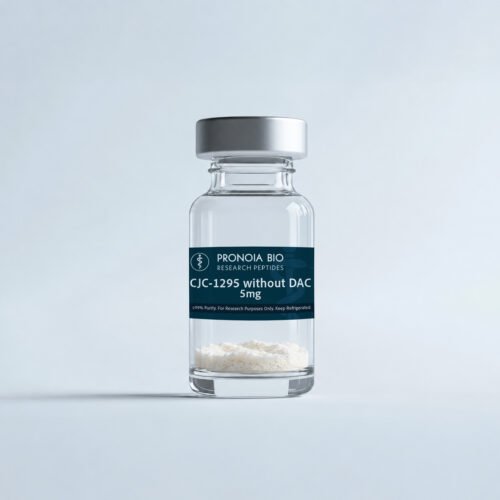
The product commonly called CJC-1295 Without DAC is generally associated with Modified GRF(1–29), in which several amino-acid substitutions are introduced to alter resistance to enzymatic degradation and peptide persistence.
This creates a useful structure–activity comparison between:
- GHRH(1–29)-based signalling
- Sequence-modified GHRH analogues
- Peptide stability
- Enzymatic degradation
- Duration of receptor stimulation
Relationship with Tesamorelin and CJC-1295 With DAC
Tesamorelin and CJC-1295 With DAC provide additional comparison points within the wider GHRH research family.
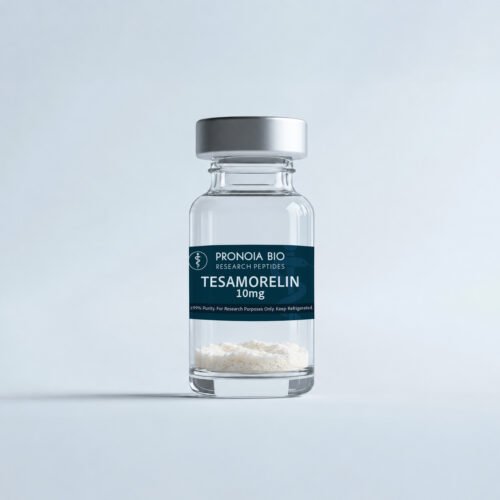
Tesamorelin is a modified GHRH analogue designed to alter peptide stability while retaining GHRH receptor activity.
CJC-1295 With DAC incorporates an albumin-binding Drug Affinity Complex to produce markedly extended peptide persistence.
These different compounds allow researchers to compare how peptide design changes:
- GHRH receptor activation
- Peptide stability
- Circulating persistence
- Duration of signalling
- Patterns of downstream GH / IGF-1 responses
Sermorelin therefore provides a particularly useful reference point within the Pronoia GHRH research range because its structure remains closely aligned with the active 1–29 region of endogenous GHRH.
Human research context
Sermorelin has an established history in controlled human endocrine research.
GHRH(1–29)-NH₂ has been used experimentally to investigate pituitary GH responsiveness, endocrine feedback and growth-hormone secretion.
Historical clinical research also investigated Sermorelin in growth-hormone-deficiency diagnostics and treatment settings.
These studies provide valuable information about the pharmacology and physiology of the Sermorelin molecule.
However, results from historical pharmaceutical preparations and controlled clinical protocols should not be interpreted as establishing safety, effectiveness or therapeutic suitability of the laboratory research material supplied by Pronoia.
Interpreting the Sermorelin evidence base
Compared with many specialist research peptides, Sermorelin has a substantial and well-characterised endocrine evidence base.
Its strongest research areas include:
- GHRH receptor pharmacology
- cAMP / PKA / CREB signalling
- Calcium-dependent pituitary secretion
- Endogenous growth-hormone synthesis and release
- Somatostatin and GH / IGF-1 feedback
- Pulsatile growth-hormone regulation
- Pituitary somatotroph biology
- GHRH peptide structure–activity relationships
The available evidence spans molecular, cellular, animal and human endocrine research.
These findings do not establish clinical efficacy, safety or suitability of the Pronoia material for human or veterinary use.
Storage & Handling
Sermorelin Acetate is supplied in lyophilised form and should be stored according to the conditions specified by Pronoia and the applicable batch documentation.
Pronoia stock is maintained in temperature-controlled cold storage and organised by identifiable batch prior to dispatch.
The material should be protected from unnecessary exposure to heat, moisture and light and handled using appropriate laboratory procedures.
Where batch-specific storage or handling information is supplied, that information should take precedence.
UK Delivery
Sermorelin Acetate is dispatched from Pronoia’s UK stock using tracked delivery.
Current availability and dispatch information are shown directly on the product page, with tracking supplied following dispatch.
Orders are prepared through Pronoia’s established research-product fulfilment process, with applicable delivery conditions remaining subject to Pronoia’s current delivery terms.
Research Use
Sermorelin Acetate supplied by Pronoia Bio is intended for laboratory research and experimental use only.
It is not supplied for human or veterinary use and should not be treated as a medicine, hormone-replacement product or consumer healthcare product.
Pronoia does not provide dosage, treatment or administration guidance for this research material.