Description
About Glutathione
Glutathione, commonly abbreviated as GSH, is a naturally occurring thiol-containing tripeptide composed of glutamate, cysteine and glycine.
It is one of the major intracellular redox buffers found across mammalian cells. Its cysteine residue contains a reactive thiol group that allows glutathione to participate in oxidation–reduction reactions and in enzyme systems involved in controlling reactive oxygen species and other electrophilic compounds.
In practical research terms, glutathione provides an important model for studying how cells maintain chemical balance during oxidative stress.
One of its best-established roles involves the glutathione redox cycle. Reduced glutathione can participate in the removal of hydrogen peroxide and other peroxides through glutathione-dependent enzymes, becoming oxidised in the process before being recycled back into its reduced form.
Glutathione also participates in cellular detoxification pathways, mitochondrial redox regulation and signalling processes influenced by the oxidation state of cellular proteins.
Together, these characteristics make glutathione relevant to laboratory studies of oxidative stress, mitochondrial biology, cellular metabolism, redox signalling and glutathione-dependent detoxification systems.
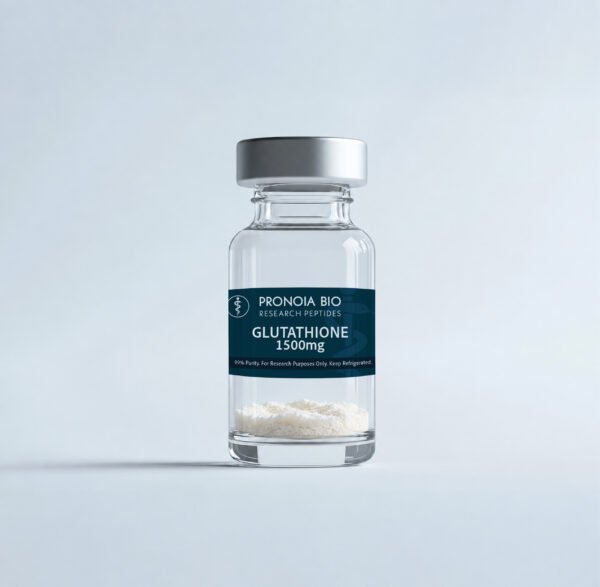
Pronoia supplies Glutathione in a 1500mg lyophilised research format with batch traceability and supporting documentation available for the supplied material.
Product Specification
Product: Glutathione
Common abbreviation: GSH
Strength: 1500mg
Material class: Thiol-containing tripeptide
Sequence: γ-L-Glutamyl-L-cysteinyl-glycine
Amino-acid components: Glutamate, cysteine and glycine
Molecular formula: C10H17N3O6S
Molecular weight: ~307.33 g/mol
Research focus: Redox regulation, oxidative stress, glutathione-dependent enzyme systems, mitochondrial biology and cellular detoxification pathways
Form: Lyophilised solid
Pronoia minimum purity standard: ≥99%
Batch traceability: Maintained
SKU: PB-GLUT-1500
Testing & Batch Documentation
Pronoia maintains a structured quality, testing and traceability process for Glutathione, with supporting documentation retained for the supplied research material.
- Batch-tested research material
- Pronoia minimum accepted purity standard of ≥99%
- Full batch traceability
- Batch-separated and labelled inventory
- Physical inventory routinely reconciled with digital stock records
- Temperature-controlled cold storage
- Certificate of Analysis (COA) and Safety Data Sheet (SDS) documentation available
The applicable Certificate of Analysis should be treated as the authoritative reference for the identity, purity and analytical results reported for an individual batch.
Research Context
Glutathione is one of the most extensively studied cellular thiols and plays a central role in experimental research examining oxidative stress and redox regulation.
Its biological activity is strongly associated with the sulfhydryl, or thiol, group present on its cysteine residue. This chemical group allows glutathione to donate reducing equivalents during oxidation–reduction reactions and to participate in several glutathione-dependent enzyme systems.
Glutathione redox cycling and peroxide research
One of the best-established research pathways involves the relationship between reduced glutathione (GSH) and oxidised glutathione (GSSG).
Glutathione peroxidase enzymes use GSH as a reducing substrate during reactions that convert hydrogen peroxide and other peroxides into less reactive products.
During these reactions:
- Reduced glutathione provides reducing equivalents
- GSH is converted into oxidised glutathione (GSSG)
- Glutathione reductase can subsequently regenerate GSH from GSSG using NADPH
The relationship between GSH and GSSG therefore provides an important experimental system for studying cellular redox state and oxidative stress.
The GSH/GSSG ratio is widely used in biochemical research as an indicator of the oxidation–reduction environment within cells.
Cellular detoxification and electrophile research
Glutathione also participates in the cellular handling of electrophilic compounds.
Glutathione S-transferase enzymes can catalyse the conjugation of glutathione to electrophilic molecules, producing modified compounds that can subsequently enter additional cellular processing or transport pathways.
This has made glutathione particularly relevant to experimental research examining:
- Glutathione S-transferase activity
- Electrophile conjugation
- Xenobiotic metabolism
- Cellular responses to chemically reactive compounds
- Oxidative and toxicological stress models
Mitochondrial redox biology
Glutathione research also extends directly into mitochondrial biology.
Mitochondria consume large amounts of oxygen during cellular respiration and consequently generate reactive oxygen species as a normal consequence of electron transport.
Mitochondrial glutathione forms part of the biochemical systems that help regulate this redox environment.
Experimental research has examined mitochondrial GSH in relation to:
- Respiration-associated reactive oxygen species
- Hydrogen-peroxide and lipid-peroxide metabolism
- Mitochondrial protein redox state
- Electron-transport-chain regulation
- Mitochondrial membrane integrity
- Cell-death and survival signalling
This makes glutathione an important research material for examining how oxidative metabolism, mitochondrial function and cellular stress responses interact.
Redox signalling and protein regulation
Glutathione does not function solely as a passive antioxidant buffer.
Research has also examined glutathionylation — the reversible attachment of glutathione to cysteine residues within proteins.
Protein glutathionylation can alter enzyme activity, protein structure and signalling behaviour, providing an additional mechanism through which cellular redox state can influence biological function.
Glutathione has consequently been investigated in relation to:
- Cellular signalling
- Protein thiol regulation
- Cell-cycle biology
- Cell proliferation and apoptosis
- Inflammatory and immune signalling
- Age-associated changes in cellular redox balance
These different research areas illustrate why glutathione is more accurately understood as a central component of cellular redox biology rather than simply as a generic “antioxidant”.
The published evidence establishes glutathione as an endogenous biochemical regulator across numerous cellular systems. Research involving purified glutathione material should nevertheless be interpreted within the specific experimental concentration, cell type, assay and model being studied.
The material supplied by Pronoia is intended for laboratory research only and these biochemical findings do not establish clinical efficacy, safety or suitability for human or veterinary use.
Storage & Handling
Glutathione is supplied in lyophilised form and should be stored according to the conditions specified by Pronoia and the applicable batch documentation.
Pronoia stock is maintained in temperature-controlled cold storage and organised by identifiable batch prior to dispatch.
Because glutathione participates readily in oxidation–reduction chemistry, the material should be protected from unnecessary exposure to heat, moisture, light and environmental conditions that may affect its chemical state.
Appropriate laboratory procedures should be used during preparation and handling.
Where batch-specific storage or handling information is supplied, that information should take precedence.
UK Delivery
Glutathione is dispatched from Pronoia’s UK stock using tracked delivery.
Current availability and dispatch information are shown directly on the product page, with tracking supplied following dispatch.
Orders are prepared through Pronoia’s established research-product fulfilment process, with applicable delivery conditions remaining subject to Pronoia’s current delivery terms.
Research Use
Glutathione supplied by Pronoia Bio is intended for laboratory research and experimental use only.
It is not supplied for human or veterinary use and should not be treated as a medicine, supplement or consumer healthcare product.
Pronoia does not provide dosage, treatment or administration guidance for this research material.