Description
About PT-141
PT-141, also known as Bremelanotide, is a synthetic cyclic heptapeptide belonging to the melanocortin family of research compounds.
Its structure can be represented as Ac-Nle-c[Asp-His-D-Phe-Arg-Trp-Lys]-OH and is closely related to Melanotan II, another synthetic cyclic analogue derived from the α-melanocyte-stimulating hormone (α-MSH) framework.
A key structural difference is found at the C-terminus: Bremelanotide carries a free carboxylic-acid group, whereas Melanotan II incorporates a C-terminal amide.
PT-141 functions as a melanocortin-receptor agonist and has been investigated across several melanocortin receptor subtypes. Particular research attention has focused on melanocortin-4 receptor (MC4R) signalling within the central nervous system.
This receptor biology has made PT-141 relevant to experimental research examining central neuroendocrine signalling, hypothalamic pathways, dopamine-associated neural systems, behavioural responses and melanocortin receptor pharmacology.
Unlike many specialist research peptides, Bremelanotide has also undergone extensive formal clinical investigation. Those studies provide additional information about melanocortin receptor biology and human pharmacology but should not be interpreted as establishing therapeutic suitability for the research material supplied by Pronoia.
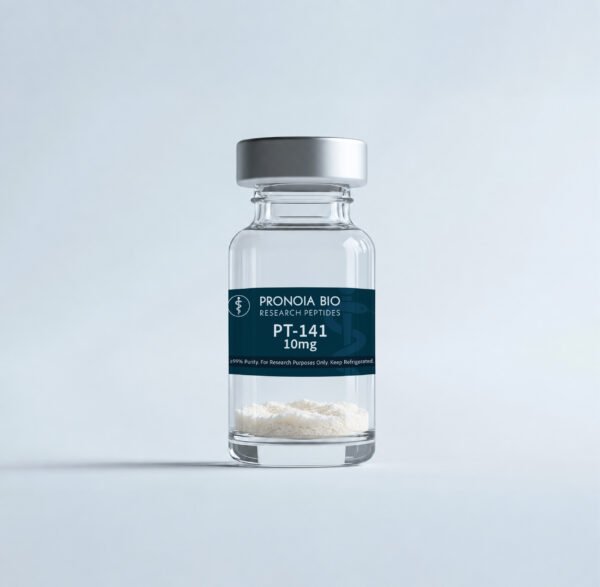
Pronoia supplies PT-141 in a 10mg lyophilised research format with batch traceability and supporting documentation available for the supplied material.
Product Specification
Product: PT-141
Alternative name: Bremelanotide
Strength: 10mg
Peptide class: Synthetic cyclic heptapeptide / melanocortin analogue
Structural framework: α-MSH / Melanotan-II-related peptide
Peptide structure: Ac-Nle-c[Asp-His-D-Phe-Arg-Trp-Lys]-OH
Primary research system: Melanocortin receptors (MCRs)
Key research receptor: MC4R
Research focus: Central melanocortin signalling, neuroendocrine regulation, sexual-response circuitry and receptor pharmacology
Form: Lyophilised solid
Pronoia minimum purity standard: ≥99%
Batch traceability: Maintained
SKU: PB-PT141-10
Testing & Batch Documentation
Pronoia maintains a structured quality, testing and traceability process for PT-141, with supporting documentation retained for the supplied research material.
- Batch-tested research material
- Pronoia minimum accepted purity standard of ≥99%
- Full batch traceability
- Batch-separated and labelled inventory
- Physical inventory routinely reconciled with digital stock records
- Temperature-controlled cold storage
- Certificate of Analysis (COA) and Safety Data Sheet (SDS) documentation available
The applicable Certificate of Analysis should be treated as the authoritative reference for the chemical form, identity, purity and analytical results reported for an individual batch.
Research Context
PT-141 has been investigated extensively as a cyclic melanocortin-receptor agonist across receptor-pharmacology, neurobiological, behavioural and human clinical research.
Melanocortin receptor pharmacology
The melanocortin receptor family consists of five G-protein-coupled receptors — MC1R through MC5R — distributed across different tissues and involved in distinct biological systems.
Bremelanotide is not completely selective for one melanocortin receptor subtype.
Pharmacological research has demonstrated agonist activity across several melanocortin receptors, with substantial experimental interest centred on MC4R.
Research involving PT-141 has therefore examined:
- Melanocortin receptor binding and activation
- MC4R-associated central nervous system signalling
- Receptor subtype selectivity
- G-protein-coupled receptor activation
- Downstream cyclic-AMP signalling
- Structure–activity relationships of melanocortin peptides
Structural studies have subsequently resolved Bremelanotide bound directly to human MC4R, providing molecular-level information about how cyclic melanocortin peptide agonists interact with and activate the receptor.
MC4R and central nervous system signalling
MC4R is expressed across multiple regions of the central nervous system and participates in a broad range of neural and neuroendocrine functions.
The receptor is particularly important within hypothalamic circuits.
Research into MC4R signalling extends across:
- Neuroendocrine regulation
- Energy-homeostasis pathways
- Autonomic signalling
- Reward and motivational systems
- Reproductive and sexual-response circuitry
Because PT-141 activates this receptor system, it has become a useful experimental compound for investigating how central melanocortin pathways influence complex physiological and behavioural outputs.
Sexual-response and neuroendocrine research
One of the most extensively investigated areas of Bremelanotide research concerns central pathways associated with sexual response.
Animal research has demonstrated melanocortin-dependent changes in reproductive and sexual behaviours, while subsequent human research examined physiological and subjective sexual-response endpoints.
The important mechanistic distinction is that this research centres principally on central melanocortin signalling rather than simply on direct peripheral vascular action.
Experimental models have investigated:
- MC3R and MC4R-associated neural pathways
- Hypothalamic signalling
- Sexual-response behaviour
- Neuroendocrine regulation
- Central motivational and reward pathways
This provides a more useful research context than reducing PT-141 to a generic “sexual-function peptide.”
Dopamine-associated neural pathways
Research has also explored interactions between melanocortin signalling and dopamine systems.
MC4R-expressing neurons have been identified within neural regions involved in motivation and reward, and experimental work has examined how central melanocortin activation may influence dopaminergic signalling.
Reviews of Bremelanotide neurobiology have proposed that MC4R activation within regions including the medial preoptic area of the hypothalamus can influence dopamine release.
More recent animal research has continued examining MC3R and MC4R expression within mesolimbic dopamine circuits, including the ventral tegmental area and nucleus accumbens.
These mechanisms remain an active research area and should not be reduced to a single fully resolved pathway.
Relationship with Melanotan II
PT-141 is structurally very closely related to Melanotan II.
Both are cyclic melanocortin agonists based on an α-MSH-derived framework.
Melanotan II can be represented as:
Ac-Nle-c[Asp-His-D-Phe-Arg-Trp-Lys]-NH₂
whereas Bremelanotide is:
Ac-Nle-c[Asp-His-D-Phe-Arg-Trp-Lys]-OH
The difference between the C-terminal amide and free carboxylic-acid forms provides a useful structure–activity comparison within melanocortin research.
Both interact with multiple melanocortin receptor subtypes, but Bremelanotide subsequently became particularly associated with research into central melanocortin and sexual-response pathways.
MC1R and wider melanocortin signalling
Although MC4R is central to much of the neurobiological research surrounding PT-141, Bremelanotide also interacts with other melanocortin receptors.
MC1R is expressed prominently in melanocytes and plays an important role in pigmentation biology.
This broader receptor activity is scientifically relevant because it demonstrates why PT-141 should be regarded as a melanocortin-system agonist rather than an absolutely selective MC4R ligand.
Research involving the compound can therefore also contribute to comparative studies examining receptor subtype activity and the biological consequences of non-selective melanocortin agonism.
Autonomic and cardiovascular pharmacology
MC4R signalling also intersects with autonomic and cardiovascular regulation.
Controlled human pharmacology research involving Bremelanotide has reported transient changes in blood pressure following exposure.
This observation provides another experimental example of the wider physiological consequences of central melanocortin-receptor signalling and reinforces that MC4R activity is not limited to one behavioural pathway.
For research purposes, PT-141 therefore provides a useful system for examining interactions between central receptor activation, neuroendocrine signalling and autonomic physiology.
Human research context
Bremelanotide is unusual within the Pronoia research catalogue because it has undergone substantial formal human clinical development.
Clinical programmes have investigated the compound across pharmacokinetics, receptor-mediated physiology, sexual-response endpoints, cardiovascular measures and longer-term safety.
A pharmaceutical preparation of Bremelanotide has been authorised by the US Food and Drug Administration for a specific medical indication.
That regulatory history provides unusually extensive pharmacological information about the Bremelanotide molecule, but it is important to distinguish an authorised pharmaceutical product from a laboratory research material.
The Pronoia product is supplied strictly as research material and should not be interpreted as equivalent to an authorised medicine in manufacturing, formulation, clinical validation or intended use.
Interpreting the PT-141 evidence base
PT-141 has a substantially broader evidence base than many specialist research peptides.
The strongest areas of research include:
- Melanocortin receptor pharmacology
- MC4R-associated central signalling
- Hypothalamic and neuroendocrine pathways
- Sexual-response circuitry and behavioural models
- Dopamine-associated neural signalling
- Autonomic and cardiovascular responses
- Melanotan-II / Bremelanotide structure–activity relationships
Although the literature includes human clinical research, those findings concern defined pharmaceutical formulations and controlled clinical conditions.
They do not establish clinical efficacy, safety or suitability of the Pronoia research material for human or veterinary use.
Storage & Handling
PT-141 is supplied in lyophilised form and should be stored according to the conditions specified by Pronoia and the applicable batch documentation.
Pronoia stock is maintained in temperature-controlled cold storage and organised by identifiable batch prior to dispatch.
The material should be protected from unnecessary exposure to heat, moisture and light and handled using appropriate laboratory procedures.
Where batch-specific storage or handling information is supplied, that information should take precedence.
UK Delivery
PT-141 is dispatched from Pronoia’s UK stock using tracked delivery.
Current availability and dispatch information are shown directly on the product page, with tracking supplied following dispatch.
Orders are prepared through Pronoia’s established research-product fulfilment process, with applicable delivery conditions remaining subject to Pronoia’s current delivery terms.
Research Use
PT-141 supplied by Pronoia Bio is intended for laboratory research and experimental use only.
It is not supplied for human or veterinary use and should not be treated as a medicine, sexual-health product or consumer healthcare product.
Pronoia does not provide dosage, treatment or administration guidance for this research material.