Description
About SS-31
SS-31, also known as Elamipretide and historically as MTP-131, is a synthetic mitochondria-targeting tetrapeptide with the sequence H-D-Arg-Dmt-Lys-Phe-NH₂, where Dmt represents the modified amino acid 2′,6′-dimethyltyrosine.
Its compact four-residue structure contains alternating aromatic and positively charged amino-acid features that contribute to its interaction with mitochondrial membranes.
Unlike many compounds investigated primarily through general antioxidant or metabolic pathways, SS-31 has a particularly well-characterised association with cardiolipin — a specialised phospholipid concentrated within the inner mitochondrial membrane.
Cardiolipin has important structural and functional roles in mitochondrial cristae, electron-transport-chain organisation, cytochrome-c activity and oxidative phosphorylation.
Research involving SS-31 therefore examines mitochondrial function at the membrane level, including cristae architecture, respiratory-chain activity, electron transfer, ATP-production efficiency and redox regulation.
This mechanistic research has expanded substantially from the earlier description of SS-31 simply as a “mitochondrial antioxidant”. Contemporary research increasingly describes its effects through cardiolipin-associated membrane organisation and mitochondrial bioenergetics.
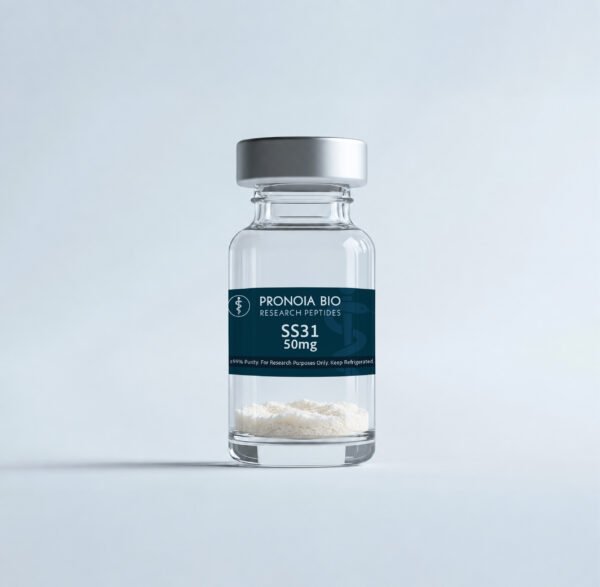
Pronoia supplies SS-31 in a 50mg lyophilised research format with batch traceability and supporting documentation available for the supplied material.
Product Specification
Product: SS-31
Alternative name: Elamipretide
Historical development name: MTP-131
Strength: 50mg
Peptide class: Aromatic-cationic synthetic tetrapeptide
Peptide length: 4 amino acids
Sequence: H-D-Arg-Dmt-Lys-Phe-NH₂
Dmt: 2′,6′-dimethyltyrosine
Primary research target: Cardiolipin-rich inner mitochondrial membrane
Research focus: Cristae architecture, electron transport, oxidative phosphorylation, ATP synthesis, mitochondrial redox regulation and cellular bioenergetics
Form: Lyophilised solid
Pronoia minimum purity standard: ≥99%
Batch traceability: Maintained
SKU: PB-SS31-50
Testing & Batch Documentation
Pronoia maintains a structured quality, testing and traceability process for SS-31, with supporting documentation retained for the supplied research material.
- Batch-tested research material
- Pronoia minimum accepted purity standard of ≥99%
- Full batch traceability
- Batch-separated and labelled inventory
- Physical inventory routinely reconciled with digital stock records
- Temperature-controlled cold storage
- Certificate of Analysis (COA) and Safety Data Sheet (SDS) documentation available
The applicable Certificate of Analysis should be treated as the authoritative reference for the exact chemical form, identity, purity and analytical results reported for an individual batch.
Research Context
SS-31 has been investigated extensively as a mitochondria-targeting peptide in biochemical, cellular, animal and human research.
Its principal research interest centres on the inner mitochondrial membrane and the specialised phospholipid cardiolipin.
Cardiolipin and the inner mitochondrial membrane
Mitochondria contain an outer membrane and a highly specialised inner mitochondrial membrane.
The inner membrane folds into structures known as cristae, substantially increasing the membrane area available for oxidative phosphorylation and ATP production.
Cardiolipin is an unusual phospholipid concentrated within this inner membrane.
It contributes to several fundamental aspects of mitochondrial biology, including:
- Organisation and curvature of mitochondrial cristae
- Stability of respiratory-chain proteins
- Organisation of respiratory complexes and supercomplexes
- Cytochrome-c interactions
- Electron transfer
- Oxidative phosphorylation
- ATP synthesis
Because these processes are closely connected, disruption of cardiolipin organisation can influence both mitochondrial structure and energy production.
SS-31 and cardiolipin binding
A defining feature of SS-31 research is its selective interaction with cardiolipin-containing membranes.
Biophysical experiments using cardiolipin-containing membrane systems have demonstrated interaction between SS-31 and cardiolipin through electrostatic and hydrophobic mechanisms.
The aromatic residues within SS-31 can associate with the membrane environment while its positively charged residues interact with the negatively charged cardiolipin head groups.
This association concentrates the research interest surrounding SS-31 specifically at the inner mitochondrial membrane rather than throughout the cell indiscriminately.
Contemporary mechanistic research continues to support cardiolipin interaction as a central feature of Elamipretide biology.
Cytochrome c and electron transport
Cytochrome c is a mitochondrial protein with an important role in transferring electrons between components of the respiratory chain.
Its relationship with cardiolipin can change depending on the biochemical state of the mitochondrial membrane.
Under certain oxidative conditions, interaction between cytochrome c and cardiolipin can promote peroxidase activity and cardiolipin oxidation, potentially disrupting mitochondrial membrane organisation.
Experimental SS-31 research has shown that interaction with cardiolipin can alter this relationship.
Published laboratory findings have included:
- Inhibition of cardiolipin-associated cytochrome-c peroxidase activity
- Preservation of cytochrome-c electron-transfer function
- Improved mitochondrial oxygen consumption under experimental conditions
- Improved efficiency of mitochondrial ATP synthesis
This creates an important mechanistic link between SS-31’s membrane interaction and downstream mitochondrial bioenergetics.
Electron-transport-chain research
The mitochondrial electron-transport chain transfers electrons through a series of membrane-associated protein complexes.
This electron transfer contributes to formation of the proton gradient that ultimately drives ATP synthesis.
Cardiolipin helps organise and stabilise components of this respiratory machinery within the inner mitochondrial membrane.
Research involving SS-31 has therefore examined:
- Respiratory-chain organisation
- Electron-transfer efficiency
- Mitochondrial oxygen consumption
- Oxidative-phosphorylation efficiency
- Respiratory supercomplex organisation
Recent experimental work continues to examine how cardiolipin-directed compounds influence the organisation and efficiency of these mitochondrial respiratory systems.
Cristae structure
Mitochondrial cristae are not merely passive folds within the inner membrane.
Their geometry and organisation influence the positioning of respiratory-chain proteins and therefore mitochondrial energy production.
Cardiolipin contributes to the highly curved membrane architecture required for normal cristae formation.
In preclinical models involving mitochondrial stress, SS-31 research has reported preservation or improvement of mitochondrial cristae morphology.
More recent work in models of defective cardiolipin metabolism has also reported changes in mitochondrial morphology, cristae density and respiratory efficiency following SS-31 exposure.
This makes mitochondrial ultrastructure an important research endpoint alongside more familiar biochemical measures such as ATP and oxygen consumption.
Oxidative phosphorylation and ATP synthesis
Oxidative phosphorylation is the principal mitochondrial process through which energy derived from nutrient metabolism is converted into ATP.
SS-31 has been investigated extensively in research examining whether stabilisation of inner-membrane biology can improve this process.
Published experimental findings have included:
- Increased state-3 mitochondrial respiration in defined experimental systems
- Improved electron-transfer efficiency
- Improved coupling of mitochondrial respiration and ATP production
- Increased or more efficient ATP synthesis under specific experimental conditions
The scientific significance of this research is that SS-31 is not simply investigated as a compound affecting general cellular “energy”.
Its primary research territory lies considerably closer to the physical mitochondrial machinery responsible for converting electron transport into ATP production.
Mitochondrial redox and oxidative-stress research
Early SS-31 literature frequently described the peptide principally as a mitochondria-targeted antioxidant.
The Dmt residue contributes to the compound’s experimentally observed radical-scavenging characteristics, and numerous preclinical studies have reported changes in mitochondrial reactive-oxygen-species production and oxidative damage.
More recent mechanistic research has produced a broader interpretation.
Rather than viewing SS-31 solely as a molecule that chemically scavenges reactive species, researchers increasingly investigate how its interaction with cardiolipin and inner-membrane organisation influences the mitochondrial processes that generate and regulate reactive oxygen species.
Relevant research therefore includes:
- Mitochondrial ROS production
- Cardiolipin oxidation
- Redox signalling
- Cytochrome-c-associated oxidative processes
- Mitochondrial membrane integrity
This membrane-centred interpretation gives a more complete account of contemporary SS-31 research than the older “mitochondrial antioxidant” description alone.
Skeletal-muscle and ageing research
Mitochondrial energetic capacity can decline in ageing-associated experimental systems.
SS-31 / Elamipretide has consequently been investigated in both animal and controlled human research examining skeletal-muscle mitochondrial bioenergetics.
A randomized placebo-controlled study in older adults with impaired mitochondrial function examined mitochondrial ATP-production capacity following Elamipretide exposure.
Researchers reported an acute increase in an in-vivo measure of mitochondrial energetic capacity following a single experimental exposure.
Separate animal work has investigated skeletal and cardiac muscle function in ageing models, including relationships between improved mitochondrial function and wider molecular markers of biological ageing.
These findings demonstrate that SS-31 research has moved beyond isolated mitochondrial preparations into intact physiological systems.
They should not be interpreted as establishing general anti-ageing or performance-enhancing effects.
Barth syndrome and cardiolipin research
Barth syndrome provides a particularly important research context because the condition involves abnormal cardiolipin remodelling caused by dysfunction of the tafazzin protein.
This creates a direct connection between cardiolipin biology, mitochondrial structure and impaired cellular bioenergetics.
SS-31 / Elamipretide has been investigated extensively in cellular, animal and clinical Barth-syndrome research.
Preclinical findings have included changes in:
- Mitochondrial morphology
- Cristae organisation
- Respiratory efficiency
- Respiratory-supercomplex organisation
- Skeletal and cardiac muscle bioenergetics
This research became particularly significant because it translated the cardiolipin-directed mechanism of SS-31 into a human mitochondrial-disease research programme.
Human clinical and regulatory research
Elamipretide has undergone substantially more formal human investigation than many specialist research peptides.
Research programmes have examined mitochondrial function across areas including skeletal muscle, inherited mitochondrial disease and cardiovascular systems.
In September 2025, the United States Food and Drug Administration granted accelerated approval to a defined prescription formulation of Elamipretide under the brand name Forzinity for improving muscle strength in adults and children with Barth syndrome weighing at least 30kg.
This was the first FDA-approved treatment for Barth syndrome and represents an unusually advanced translational research history for the SS-31 molecule.
However, this distinction is particularly important:
The approved pharmaceutical product is a specifically manufactured, formulated, clinically evaluated prescription medicine.
The existence of an FDA-approved Elamipretide medicine does not mean that generic SS-31 research material is an approved medicine or that the Pronoia product is equivalent to Forzinity in manufacturing, formulation, sterility, clinical validation, intended use or regulatory status.
Pronoia SS-31 is supplied strictly as laboratory research material.
Current mitochondrial research
Research into Elamipretide continues to evolve.
Recent work has expanded the mechanistic model beyond simple cardiolipin protection to examine how SS-31 influences:
- Inner-membrane electrostatic properties
- Cardiolipin-dependent protein organisation
- Respiratory-chain assembly
- Mitochondrial membrane architecture
- Oxidative-phosphorylation efficiency
A 2026 review of cardiolipin-directed mitochondrial therapeutics also places Elamipretide within the wider study of cardiolipin remodelling, respiratory-supercomplex stability and mitochondrial membrane mechanics.
This continuing work demonstrates that SS-31 remains an active mechanistic research tool rather than a peptide whose scientific story is considered complete.
Interpreting the SS-31 evidence base
The strongest areas of SS-31 / Elamipretide research currently include:
- Cardiolipin binding and inner-mitochondrial-membrane biology
- Mitochondrial cristae structure
- Cytochrome-c function
- Electron-transport-chain activity
- Respiratory-supercomplex organisation
- Oxidative phosphorylation
- ATP-production efficiency
- Mitochondrial redox and ROS regulation
- Skeletal and cardiac muscle bioenergetics
- Barth-syndrome and cardiolipin-remodelling models
The evidence base spans biochemical systems, cultured cells, animal models and controlled human research.
Findings from clinical research or authorised pharmaceutical formulations do not establish clinical efficacy, safety or suitability of the Pronoia research material for human or veterinary use.
Storage & Handling
SS-31 is supplied in lyophilised form and should be stored according to the conditions specified by Pronoia and the applicable batch documentation.
Pronoia stock is maintained in temperature-controlled cold storage and organised by identifiable batch prior to dispatch.
The material should be protected from unnecessary exposure to heat, moisture and light and handled using appropriate laboratory procedures.
Where batch-specific storage or handling information is supplied, that information should take precedence.
UK Delivery
SS-31 is dispatched from Pronoia’s UK stock using tracked delivery.
Current availability and dispatch information are shown directly on the product page, with tracking supplied following dispatch.
Orders are prepared through Pronoia’s established research-product fulfilment process, with applicable delivery conditions remaining subject to Pronoia’s current delivery terms.
Research Use
SS-31 supplied by Pronoia Bio is intended for laboratory research and experimental use only.
It is not supplied for human or veterinary use and should not be treated as a medicine, mitochondrial therapy, anti-ageing product or consumer healthcare product.
Pronoia does not provide dosage, treatment or administration guidance for this research material.