Description
About Kisspeptin-10
Kisspeptin-10 is a ten-amino-acid neuroendocrine research peptide with the sequence Tyr-Asn-Trp-Asn-Ser-Phe-Gly-Leu-Arg-Phe-NH₂.
It represents the C-terminal ten-amino-acid region shared by the larger kisspeptin peptides produced from the KISS1 precursor and is the shortest kisspeptin sequence retaining full intrinsic biological activity.
Kisspeptin signalling plays a major role in regulating the hypothalamic–pituitary–gonadal axis — the neural and hormonal signalling system involved in reproductive endocrine function.
Kisspeptin-10 activates the kisspeptin receptor, commonly known as KISS1R or GPR54. This signalling acts upstream of gonadotropin-releasing hormone (GnRH), providing researchers with a way to investigate how hypothalamic signalling controls downstream luteinizing hormone (LH), follicle-stimulating hormone (FSH) and wider reproductive-axis activity.
Controlled experimental research has demonstrated particularly strong effects on LH secretion and LH pulsatility, making Kisspeptin-10 relevant to studies examining GnRH neuronal activity, hormonal feedback and neuroendocrine regulation.
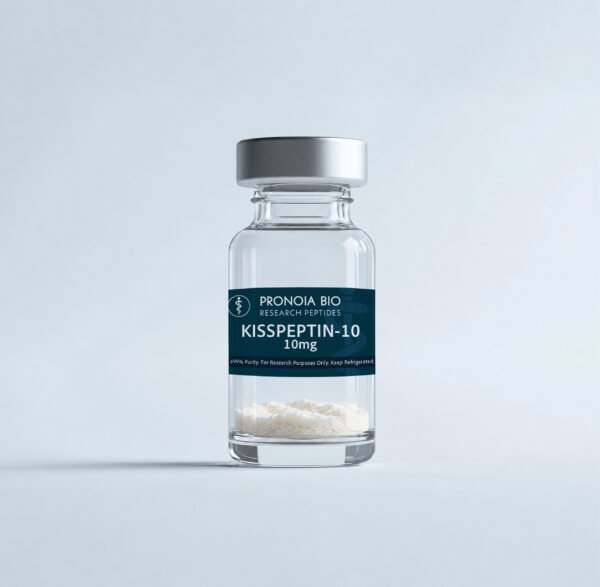
Pronoia supplies Kisspeptin-10 in a 10mg lyophilised research format with batch traceability and supporting documentation available for the supplied material.
Product Specification
Product: Kisspeptin-10
Strength: 10mg
Peptide class: Neuropeptide / decapeptide
Peptide length: 10 amino acids
Sequence: H-Tyr-Asn-Trp-Asn-Ser-Phe-Gly-Leu-Arg-Phe-NH₂
Sequence notation: YNWNSFGLRF-NH₂
C-terminal modification: Amidated
Research target: KISS1R / GPR54 receptor
Research focus: GnRH signalling, LH and gonadotropin regulation, reproductive-axis biology and neuroendocrine signalling
Form: Lyophilised solid
Pronoia minimum purity standard: ≥99%
Batch traceability: Maintained
SKU: PB-KISS-10
Testing & Batch Documentation
Pronoia maintains a structured quality, testing and traceability process for Kisspeptin-10, with supporting documentation retained for the supplied research material.
- Batch-tested research material
- Pronoia minimum accepted purity standard of ≥99%
- Full batch traceability
- Batch-separated and labelled inventory
- Physical inventory routinely reconciled with digital stock records
- Temperature-controlled cold storage
- Certificate of Analysis (COA) and Safety Data Sheet (SDS) documentation available
The applicable Certificate of Analysis should be treated as the authoritative reference for the identity, purity and analytical results reported for an individual batch.
Research Context
Kisspeptin signalling is recognised as a major upstream regulator of gonadotropin-releasing hormone (GnRH) neurons and therefore of the wider hypothalamic–pituitary–gonadal axis.
GnRH is released from specialised hypothalamic neurons and subsequently stimulates the pituitary gland to release the gonadotropins luteinizing hormone (LH) and follicle-stimulating hormone (FSH).
Kisspeptin provides an important regulatory signal upstream of this process.
KISS1R / GPR54 signalling
Kisspeptin-10 activates the kisspeptin receptor KISS1R, historically known as GPR54.
Experimental research has shown that kisspeptin signalling can directly increase the electrical activity of GnRH neurons, supporting increased GnRH release and subsequent downstream gonadotropin signalling.
This places the kisspeptin system at an important control point between neural signalling and endocrine hormone release.
Research using Kisspeptin-10 has therefore examined:
- KISS1R / GPR54 receptor activation
- GnRH-neuron signalling
- LH secretion and pulsatility
- FSH and wider gonadotropin responses
- Hypothalamic–pituitary–gonadal axis regulation
- Hormonal feedback within reproductive neuroendocrine systems
Human reproductive-axis research
Controlled human studies have provided a particularly useful experimental picture of Kisspeptin-10 activity.
In healthy men, researchers reported that Kisspeptin-10 produced dose-dependent increases in circulating LH.
Detailed analysis of pulsatile hormone secretion also showed an increase in LH pulse frequency under the experimental conditions used.
Because LH pulsatility provides an indirect measure of pulsatile hypothalamic GnRH activity, these findings support the use of Kisspeptin-10 as a research tool for investigating the upstream neural regulation of reproductive hormone secretion.
Separate controlled research comparing Kisspeptin-10, Kisspeptin-54 and GnRH demonstrated that both kisspeptin forms could increase gonadotropin secretion in healthy men, while direct GnRH stimulation produced a stronger pituitary response at the doses studied.
These experiments help distinguish the biological position of kisspeptin from GnRH itself: Kisspeptin-10 primarily operates upstream by stimulating the GnRH neuronal system rather than functioning simply as another direct pituitary gonadotropin-releasing signal.
Biological context and hormonal feedback
Responses to Kisspeptin-10 can vary according to biological and hormonal context.
Human studies have reported differences in gonadotropin responses between men and women and across different reproductive states.
This variability reflects the wider role of kisspeptin neurons in integrating signals associated with sex-steroid feedback and other biological inputs before regulating GnRH activity.
The broader kisspeptin research field has consequently investigated:
- Sex-steroid feedback regulation
- Puberty-associated activation of the reproductive axis
- GnRH pulse generation
- Interactions with neurokinin B and dynorphin signalling
- Sex-dependent and reproductive-state-dependent responses
- Neuroendocrine integration of reproductive signalling
The interaction between kisspeptin, neurokinin B and dynorphin is often described as the KNDy signalling network and forms an important area of research into how GnRH pulsatility is generated and regulated.
Why Kisspeptin-10 is useful experimentally
Larger biologically active kisspeptin forms include Kisspeptin-54, Kisspeptin-14 and Kisspeptin-13.
All contain the same C-terminal sequence represented by Kisspeptin-10.
The ten-amino-acid fragment retains full intrinsic activity at KISS1R, making it a compact and defined research material for experiments examining kisspeptin receptor signalling and reproductive neuroendocrine biology.
Together, the available evidence makes Kisspeptin-10 particularly relevant to experimental research examining KISS1R activation, GnRH neuronal signalling, LH pulsatility, gonadotropin secretion and regulation of the reproductive endocrine axis.
The published evidence includes laboratory, animal and controlled human physiology studies. Responses can differ considerably according to biological context, and these findings do not establish clinical efficacy, safety or suitability for human or veterinary use.
Storage & Handling
Kisspeptin-10 is supplied in lyophilised form and should be stored according to the conditions specified by Pronoia and the applicable batch documentation.
Pronoia stock is maintained in temperature-controlled cold storage and organised by identifiable batch prior to dispatch.
The material should be protected from unnecessary exposure to heat, moisture and light and handled using appropriate laboratory procedures.
Solubility and preparation conditions can depend on the supplied peptide form, concentration and experimental system. Researchers should therefore follow validated laboratory procedures and any batch-specific information provided with the material.
Where batch-specific storage or handling information is supplied, that information should take precedence.
UK Delivery
Kisspeptin-10 is dispatched from Pronoia’s UK stock using tracked delivery.
Current availability and dispatch information are shown directly on the product page, with tracking supplied following dispatch.
Orders are prepared through Pronoia’s established research-product fulfilment process, with applicable delivery conditions remaining subject to Pronoia’s current delivery terms.
Research Use
Kisspeptin-10 supplied by Pronoia Bio is intended for laboratory research and experimental use only.
It is not supplied for human or veterinary use and should not be treated as a medicine or consumer healthcare product.
Pronoia does not provide dosage, treatment or administration guidance for this research material.