Description
About Semax
Semax is a synthetic seven-amino-acid research peptide with the sequence Met-Glu-His-Phe-Pro-Gly-Pro, commonly represented as MEHFPGP.
Its structure combines the Met-Glu-His-Phe sequence corresponding to ACTH(4–7) with a C-terminal Pro-Gly-Pro (PGP) tripeptide.
This design places Semax within a specialised area of ACTH-fragment and regulatory-peptide research without retaining the full hormonal structure of adrenocorticotropic hormone.
Semax has been investigated extensively in neurobiological research, particularly in experimental systems examining neurotrophin signalling, neuronal responses to metabolic and ischaemic stress, gene-expression regulation and interactions between inflammatory and neurotransmitter pathways.
Published research has reported changes in brain-derived neurotrophic factor (BDNF), nerve growth factor (NGF) and several Trk neurotrophin receptors, alongside wider transcriptomic and protein-expression changes in neural tissue.
These areas make Semax relevant to research examining how short peptide sequences influence neural-cell signalling, neurotrophin regulation and cellular responses to neurological stress.
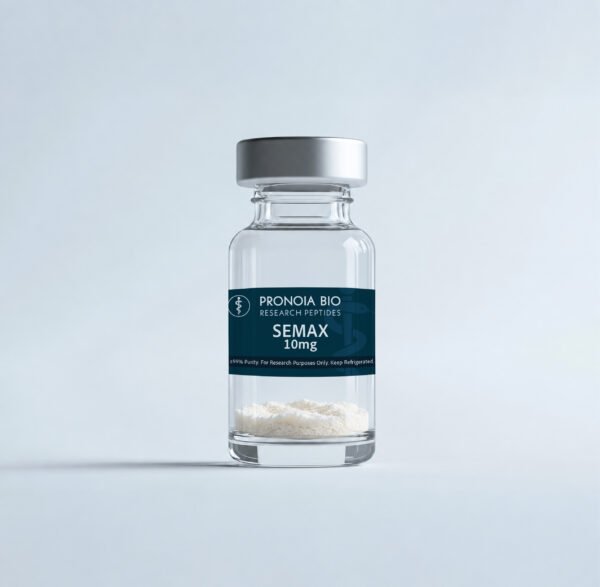
Pronoia supplies Semax in a 10mg lyophilised research format with batch traceability and supporting documentation available for the supplied material.
Product Specification
Product: Semax
Strength: 10mg
Peptide class: Synthetic heptapeptide / ACTH-fragment-derived peptide
Peptide length: 7 amino acids
Sequence: H-Met-Glu-His-Phe-Pro-Gly-Pro-OH
Sequence notation: MEHFPGP
Structural framework: ACTH(4–7) + Pro-Gly-Pro (PGP)
Research pathways: BDNF, NGF and Trk-associated neurotrophin signalling
Research focus: Neurotrophin regulation, neuronal stress-response biology, cerebral-ischaemia models and neural gene-expression signalling
Form: Lyophilised solid
Pronoia minimum purity standard: ≥99%
Batch traceability: Maintained
SKU: PB-SEMAX-10
Testing & Batch Documentation
Pronoia maintains a structured quality, testing and traceability process for Semax, with supporting documentation retained for the supplied research material.
- Batch-tested research material
- Pronoia minimum accepted purity standard of ≥99%
- Full batch traceability
- Batch-separated and labelled inventory
- Physical inventory routinely reconciled with digital stock records
- Temperature-controlled cold storage
- Certificate of Analysis (COA) and Safety Data Sheet (SDS) documentation available
The applicable Certificate of Analysis should be treated as the authoritative reference for the chemical form, identity, purity and analytical results reported for an individual batch.
Research Context
Semax has been investigated across molecular, cellular, animal and limited human neurobiological research.
Its experimental profile is particularly associated with neurotrophin regulation and with changes in gene and protein expression during neural stress.
ACTH-fragment and PGP structure
Semax contains the four-amino-acid sequence Met-Glu-His-Phe, corresponding to residues 4–7 of adrenocorticotropic hormone (ACTH), followed by the Pro-Gly-Pro tripeptide.
The resulting sequence is:
Met-Glu-His-Phe-Pro-Gly-Pro
This structure has made Semax useful in research examining how short ACTH-derived peptide sequences can retain neurobiological activity without reproducing the complete hormonal structure of ACTH.
The C-terminal PGP region has also been investigated independently and in comparison with Semax, allowing researchers to examine which molecular effects are associated with the complete heptapeptide and which may be influenced by its terminal sequence.
BDNF and TrkB signalling
One of the best characterised areas of Semax research concerns brain-derived neurotrophic factor, or BDNF.
BDNF is a neurotrophin involved in neuronal survival, synaptic regulation and activity-dependent neural plasticity.
Its biological effects are mediated substantially through the TrkB receptor.
In rat hippocampal research, Semax exposure was associated with:
- Increased BDNF protein levels
- Increased Bdnf gene-expression measures
- Increased TrkB gene expression
- Increased TrkB receptor phosphorylation
Researchers also observed changes in conditioned-learning behaviour within the same experimental programme.
These findings provided an important mechanistic link between Semax and the BDNF / TrkB neurotrophin system.
The behavioural findings derive from animal experiments and should not be interpreted as demonstrating an established cognitive-enhancement effect in humans.
BDNF and NGF gene-expression dynamics
Separate experiments have investigated both BDNF and nerve growth factor (NGF).
NGF is another major neurotrophin involved in neuronal development, maintenance and cellular signalling.
In rat hippocampus and frontal cortex, researchers reported rapid and region-dependent changes in Bdnf and Ngf expression following Semax exposure.
Earlier glial-cell experiments also reported substantial short-term changes in BDNF and NGF messenger-RNA levels.
The timing and direction of these responses differed according to brain region and experimental interval, illustrating that Semax-associated neurotrophin regulation is dynamic rather than simply producing a permanent increase in one growth factor.
Cerebral-ischaemia research
A substantial part of the Semax literature comes from experimental models of cerebral ischaemia.
Researchers have used transient and permanent middle-cerebral-artery occlusion models in rats to investigate how Semax affects molecular responses following reduced cerebral blood flow.
Published findings have included changes involving:
- BDNF and NGF expression
- TrkA, TrkB and TrkC neurotrophin receptors
- Inflammatory-response gene expression
- Neurotransmitter-associated gene expression
- Cell-death and stress-response pathways
- Recovery-associated transcriptional signalling
In one experimental study following cerebral ischaemia, Semax altered transcription of several neurotrophins and their receptors, including Bdnf, Ngf, Nt-3 and members of the Trk receptor family at different post-ischaemic time points.
These findings have helped establish cerebral-ischaemia models as one of the principal experimental contexts for Semax research.
Inflammatory and neurotransmitter gene regulation
Genome-wide and targeted gene-expression research has expanded the Semax evidence base beyond individual neurotrophins.
Transcriptomic studies in rat cerebral-ischaemia models have reported that Semax influenced large groups of genes associated with:
- Inflammatory signalling
- Immune-response pathways
- Neurotransmitter signalling
- Cellular stress responses
- Neural recovery-associated processes
In several experiments, Semax partially reduced disruption of gene-expression profiles caused by experimentally induced cerebral ischaemia.
More recent transcriptomic research has continued to identify Semax-associated changes in hundreds of genes within rat frontal-cortex tissue, reinforcing the view that its experimental activity involves broad regulatory networks rather than one isolated receptor target.
Protein-expression research
Researchers have also investigated whether changes observed at the RNA level are reflected in proteins involved in cellular stress and recovery.
In rat cerebral-ischaemia models, Semax-associated changes have been reported in proteins including:
- CREB, a transcription factor involved in neuronal signalling and plasticity
- MMP-9, associated with extracellular-matrix and inflammatory responses
- c-Fos, an immediate-early gene product used as a marker of cellular activation
- JNK, a stress-activated signalling protein
These findings extend the research context beyond transcription alone and support investigation of Semax across interacting gene- and protein-regulatory pathways.
Neural plasticity and learning-associated research
Because BDNF, TrkB, CREB and related signalling systems participate in synaptic and neural-plasticity processes, Semax has also been investigated in experimental learning and memory models.
Animal studies have reported changes in conditioned learning and other behavioural measures alongside neurotrophin signalling responses.
This provides a biological basis for research examining relationships between Semax and learning-associated neural pathways.
However, terms such as “focus enhancer”, “memory booster” or “nootropic” simplify a considerably more complex evidence base.
For Pronoia, the more accurate research framing is neurotrophin signalling, neural plasticity and behavioural-model investigation rather than presenting cognitive improvement as an established product effect.
Human research context
Some clinical research involving Semax has been published, particularly in Russian studies involving ischaemic stroke and rehabilitation.
Reported research has examined neurological-function measures, BDNF concentrations and rehabilitation outcomes.
These studies are scientifically relevant when describing the overall Semax literature, but the human evidence base remains substantially narrower than the preclinical and molecular literature and originates predominantly from a limited geographical research network.
For this reason, findings from these studies should not be interpreted as establishing internationally accepted clinical efficacy or as supporting therapeutic use of the research material supplied by Pronoia.
Interpreting the Semax evidence base
Semax has a more developed experimental literature than many specialist short peptides, but its research remains concentrated heavily within particular Russian research institutes and cerebral-ischaemia research programmes.
The strongest mechanistic evidence currently supports research involving:
- BDNF and NGF neurotrophin regulation
- Trk receptor signalling
- Neural gene-expression responses
- Inflammatory and neurotransmitter pathway regulation
- Cerebral-ischaemia and neuronal-stress models
- Neural plasticity-associated signalling
- ACTH-fragment peptide structure–activity relationships
The evidence base includes molecular, cellular, animal and limited human studies, and these evidence types should not be treated as equivalent.
The published findings do not establish clinical efficacy, safety or suitability for human or veterinary use.
Storage & Handling
Semax is supplied in lyophilised form and should be stored according to the conditions specified by Pronoia and the applicable batch documentation.
Pronoia stock is maintained in temperature-controlled cold storage and organised by identifiable batch prior to dispatch.
The material should be protected from unnecessary exposure to heat, moisture and light and handled using appropriate laboratory procedures.
Where batch-specific storage or handling information is supplied, that information should take precedence.
UK Delivery
Semax is dispatched from Pronoia’s UK stock using tracked delivery.
Current availability and dispatch information are shown directly on the product page, with tracking supplied following dispatch.
Orders are prepared through Pronoia’s established research-product fulfilment process, with applicable delivery conditions remaining subject to Pronoia’s current delivery terms.
Research Use
Semax supplied by Pronoia Bio is intended for laboratory research and experimental use only.
It is not supplied for human or veterinary use and should not be treated as a medicine, cognitive-enhancement product or consumer healthcare product.
Pronoia does not provide dosage, treatment or administration guidance for this research material.