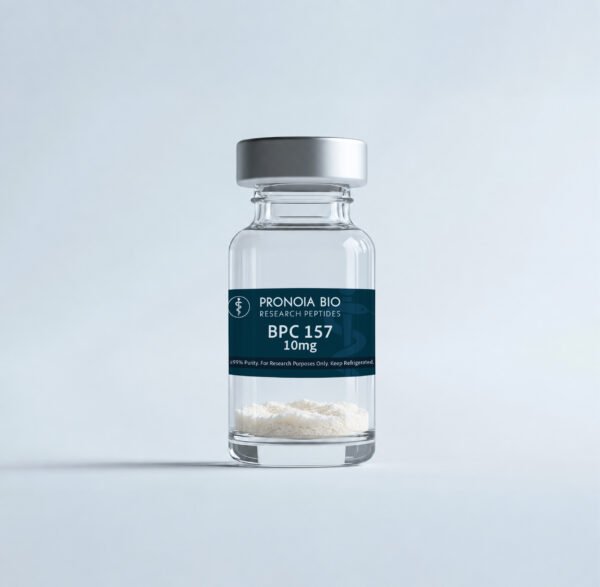
Description
About BPC-157
BPC-157 is a synthetic pentadecapeptide composed of a defined sequence of 15 amino acids.
It has been investigated across experimental research involving fibroblast behaviour, cell migration and adhesion, connective-tissue biology, vascular signalling and biological processes associated with tissue repair.
Published laboratory research using tendon-derived fibroblasts has reported increased cell migration and spreading under controlled conditions, alongside changes in F-actin formation and FAK-paxillin signalling — processes associated with how cells organise, attach and move.
Separate preclinical and cell-based studies have investigated BPC-157 in angiogenesis and endothelial-cell models, including research examining blood-vessel formation and VEGFR2-Akt-eNOS-associated signalling.
Together, these research areas have made BPC-157 relevant to experimental studies of tendon and connective-tissue biology, cellular migration, vascular responses and tissue-repair-related processes.
Pronoia supplies BPC-157 in a 10mg lyophilised research format with batch traceability and supporting documentation available for the supplied material.
Product Specification
Product: BPC-157
Strength: 10mg
Material class: Synthetic pentadecapeptide
Peptide length: 15 amino acids
Sequence: H-Gly-Glu-Pro-Pro-Pro-Gly-Lys-Pro-Ala-Asp-Asp-Ala-Gly-Leu-Val-OH
Sequence notation: GEPPPGKPADDAGLV
Research focus: Fibroblast migration, connective-tissue biology, cell adhesion and angiogenic signalling
Form: Lyophilised solid
Pronoia minimum purity standard: ≥99%
Batch traceability: Maintained
SKU: PB-BPC-10
Testing & Batch Documentation
Pronoia maintains a structured quality, testing and traceability process for BPC-157, with supporting documentation retained for the supplied research material.
- Batch-tested research material
- Pronoia minimum accepted purity standard of ≥99%
- Full batch traceability
- Batch-separated and labelled inventory
- Physical inventory routinely reconciled with digital stock records
- Temperature-controlled cold storage
- Certificate of Analysis (COA) and Safety Data Sheet (SDS) documentation available
The applicable Certificate of Analysis should be treated as the authoritative reference for the identity, purity and analytical results reported for an individual batch.
Research Context
BPC-157 has been investigated across laboratory cell systems and preclinical animal models involving fibroblast behaviour, connective tissue, cellular migration and vascular signalling.
One established area of laboratory research has involved tendon-derived fibroblasts — cells that contribute to the production and maintenance of connective-tissue structure.
Under the experimental conditions used, researchers reported:
- Increased migration of tendon-derived fibroblasts
- Increased spreading of fibroblasts in cell culture
- Increased cell survival under experimentally induced oxidative stress
- Increased F-actin formation associated with cellular structure and movement
- Increased activation of FAK and paxillin, signalling proteins involved in cell adhesion and migration
These findings have made BPC-157 particularly relevant to experimental research examining fibroblast behaviour, tendon and connective-tissue biology, and the cellular processes involved in tissue-response models.
A separate body of research has examined BPC-157 in endothelial and angiogenesis-related systems. Endothelial cells form the inner lining of blood vessels and play an important role in vascular growth and remodelling.
Reported experimental findings have included:
- Increased vessel formation in controlled angiogenesis models
- Increased endothelial-cell migration and tube formation in laboratory systems
- Changes in VEGFR2 expression and internalisation
- Activation of VEGFR2-Akt-eNOS-associated signalling pathways
More recent experimental research has continued to investigate BPC-157 in endothelial-cell proliferation, migration, tube formation and additional signalling mechanisms involved in angiogenesis.
Beyond these cell-based systems, the wider BPC-157 literature includes preclinical models involving tendon, ligament, muscle, bone and other tissue-response processes.
The overall evidence base remains predominantly preclinical. Findings from cell-culture and animal studies should therefore be interpreted within their specific experimental settings and do not establish equivalent effects, clinical efficacy or safety in humans.
Storage & Handling
BPC-157 is supplied in lyophilised form and should be stored according to the conditions specified by Pronoia and the applicable batch documentation.
Pronoia stock is maintained in temperature-controlled cold storage and organised by identifiable batch prior to dispatch.
The material should be protected from unnecessary exposure to heat, moisture and light and handled using appropriate laboratory procedures.
Where batch-specific storage or handling information is supplied, that information should take precedence.
UK Delivery
BPC-157 is dispatched from Pronoia’s UK stock using tracked delivery.
Current availability and dispatch information are shown directly on the product page, with tracking supplied following dispatch.
Orders are prepared through Pronoia’s established research-product fulfilment process, with applicable delivery conditions remaining subject to Pronoia’s current delivery terms.
Research Use
BPC-157 supplied by Pronoia Bio is intended for laboratory research and experimental use only.
It is not supplied for human or veterinary use and should not be treated as a medicine or consumer healthcare product.
Pronoia does not provide dosage, treatment or administration guidance for this research material.