Description
About GHK-Cu
GHK-Cu is a copper-binding tripeptide complex formed from glycyl-L-histidyl-L-lysine (GHK) and copper(II). It is also commonly referred to as Copper Tripeptide-1 or GHK Copper.
GHK is a naturally occurring three-amino-acid peptide originally identified in human plasma and has a strong affinity for copper ions. Binding copper creates the GHK-Cu complex, making it relevant both to research into peptide–metal interactions and to wider studies of copper-associated cellular signalling.
GHK-Cu has been studied particularly extensively in fibroblasts — cells involved in producing and organising the extracellular matrix that gives connective tissues much of their structure.
In experimental systems, researchers have reported increased collagen production, changes in glycosaminoglycan synthesis and modulation of enzymes involved in extracellular-matrix turnover. These findings have made GHK-Cu relevant to studies examining how connective tissue is produced, broken down and remodelled during tissue-response and wound-repair processes.
Research has also examined GHK-Cu in relation to fibroblast proliferation, growth-factor signalling and angiogenesis-related biology, extending its experimental context into cellular repair and vascular-response models.
Wider GHK-Cu literature includes skin and hair-follicle-related research, although those areas should be distinguished from the stronger laboratory and preclinical evidence surrounding fibroblasts, collagen and extracellular-matrix remodelling.
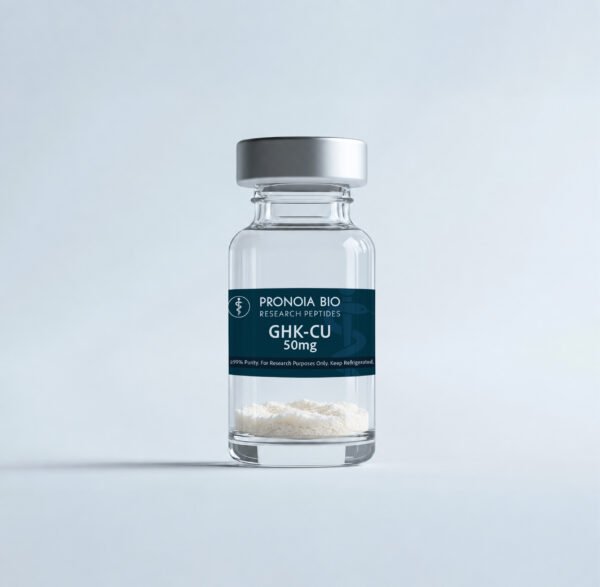
Pronoia supplies GHK-Cu in a 50mg research format with batch traceability and supporting documentation available for the supplied material.
Product Specification
Product: GHK-Cu
Alternative names: Copper Tripeptide-1 / GHK Copper
Strength: 50mg
Material class: Tripeptide–copper complex
Peptide component: Glycyl-L-histidyl-L-lysine
Sequence notation: GHK
Peptide length: 3 amino acids
Copper component: Copper(II)
Research focus: Fibroblast activity, collagen and extracellular-matrix biology, tissue remodelling and vascular signalling
Form: Solid / lyophilised research material (batch dependent)
Appearance: Blue to blue-green
Pronoia minimum purity standard: ≥99%
Batch traceability: Maintained
SKU: PB-GHKCU-50
Testing & Batch Documentation
Pronoia maintains a structured quality, testing and traceability process for GHK-Cu, with supporting documentation retained for the supplied research material.
- Batch-tested research material
- Pronoia minimum accepted purity standard of ≥99%
- Full batch traceability
- Batch-separated and labelled inventory
- Physical inventory routinely reconciled with digital stock records
- Temperature-controlled cold storage
- Certificate of Analysis (COA) and Safety Data Sheet (SDS) documentation available
Because GHK-Cu contains coordinated copper, supplied material may show some variation in blue or blue-green appearance between batches. Visual appearance alone should not be used to determine analytical quality.
The applicable Certificate of Analysis should be treated as the authoritative reference for the identity, purity and analytical results reported for an individual batch.
Research Context
GHK-Cu has been investigated extensively in experimental models examining connective-tissue production, extracellular-matrix remodelling and fibroblast biology.
The extracellular matrix is the network of proteins and other molecules surrounding cells that provides structural support to tissues. Fibroblasts are major producers of this matrix and therefore provide an important experimental model for studying tissue formation and remodelling.
One established area of GHK-Cu research concerns collagen production.
In cultured human fibroblasts, researchers reported increased collagen synthesis following GHK-Cu exposure. The effect occurred without a corresponding increase in cell number, indicating an experimental change in collagen production rather than simply the presence of more fibroblasts.
Research has also examined glycosaminoglycans — carbohydrate-rich components of the extracellular matrix that contribute to tissue structure and cellular interactions.
Under experimental conditions, GHK-Cu was reported to increase synthesis of several extracellular-matrix-associated glycosaminoglycans, including dermatan sulfate and heparan sulfate.
These cell-based findings have also been investigated in preclinical wound models.
In rat experimental wound chambers, researchers reported GHK-Cu-associated increases in:
- Total connective-tissue accumulation
- Collagen content
- Type I and type III collagen gene expression
- Glycosaminoglycan accumulation
- Total protein and DNA content within the experimental wound environment
These findings established an important research connection between GHK-Cu and the biological processes involved in connective-tissue formation during wound and tissue-response models.
GHK-Cu research is not limited to producing new extracellular matrix. It has also examined how existing matrix is remodelled.
Researchers using dermal fibroblasts reported increased expression of matrix metalloproteinase-2 (MMP-2), an enzyme involved in extracellular-matrix breakdown and reorganisation.
The same experiments also reported increased secretion of TIMP-1 and TIMP-2, natural inhibitors that regulate metalloproteinase activity.
This combination makes GHK-Cu particularly relevant to research examining the balance between:
- Production of new extracellular-matrix components
- Breakdown of existing matrix
- Controlled matrix remodelling
- Fibroblast-mediated tissue responses
Separate experiments have examined fibroblast growth and growth-factor signalling.
In studies using normal and previously irradiated human dermal fibroblasts, GHK-Cu exposure was associated with faster fibroblast population doubling. Researchers also reported increased production of basic fibroblast growth factor (FGF-2) and vascular endothelial growth factor (VEGF) under specific experimental conditions.
VEGF is an important signalling protein in blood-vessel formation, making these findings relevant to the wider investigation of vascular and angiogenesis-related processes during tissue repair.
Other preclinical studies using GHK-Cu-containing experimental formulations have investigated endothelial-cell proliferation, blood-vessel formation and wound-response biology.
The wider GHK-Cu literature has additionally explored:
- Skin-cell and keratinocyte biology
- Collagen and elastin-associated processes
- Inflammatory and oxidative-stress signalling
- Gene-expression regulation
- Angiogenesis and vascular responses
- Hair-follicle-related biology
Hair-related findings should be interpreted more cautiously than the fibroblast and extracellular-matrix literature. Although GHK-Cu is frequently discussed in relation to hair-follicle biology, the direct evidence for GHK-Cu itself remains considerably less developed than its laboratory and preclinical tissue-remodelling evidence.
It is also important to distinguish research involving the copper-bound GHK-Cu complex from experiments using copper-free GHK or related copper-binding peptides. Findings involving those materials should not automatically be treated as identical results for GHK-Cu.
Together, the evidence makes GHK-Cu particularly relevant to experimental research examining fibroblast behaviour, collagen production, extracellular-matrix formation and remodelling, wound-response biology and associated vascular signalling.
These findings derive from specific laboratory, preclinical and formulation-dependent experimental systems. They do not establish clinical efficacy, safety or suitability for human or veterinary use.
Storage & Handling
GHK-Cu should be stored according to the conditions specified by Pronoia and the applicable batch documentation.
Pronoia stock is maintained in temperature-controlled cold storage and organised by identifiable batch prior to dispatch.
The material should be protected from unnecessary exposure to heat, moisture and light and handled using appropriate laboratory procedures.
Because GHK-Cu contains coordinated copper, some variation in blue or blue-green appearance may occur between supplied materials. Batch documentation and analytical results should be used when assessing product specification rather than colour alone.
Where batch-specific storage or handling information is supplied, that information should take precedence.
UK Delivery
GHK-Cu is dispatched from Pronoia’s UK stock using tracked delivery.
Current availability and dispatch information are shown directly on the product page, with tracking supplied following dispatch.
Orders are prepared through Pronoia’s established research-product fulfilment process, with applicable delivery conditions remaining subject to Pronoia’s current delivery terms.
Research Use
GHK-Cu supplied by Pronoia Bio is intended for laboratory research and experimental use only.
It is not supplied for human or veterinary use and should not be treated as a medicine or consumer healthcare product.
Pronoia does not provide dosage, treatment or administration guidance for this research material.