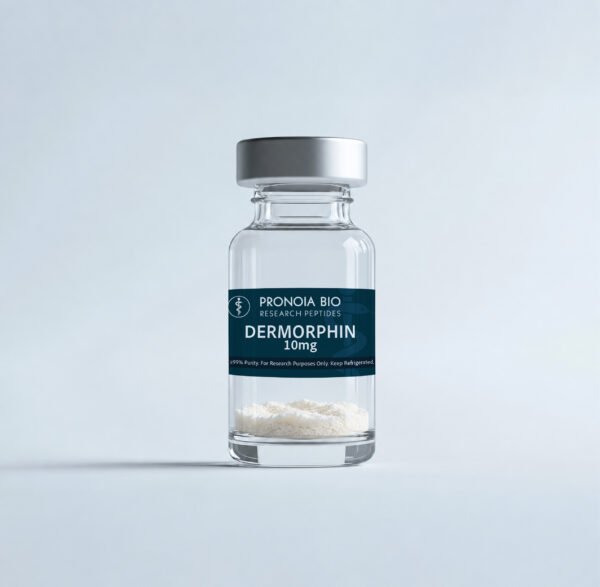
Description
About Dermorphin
Dermorphin is a seven-amino-acid opioid research peptide originally identified in the skin of the South American frog Phyllomedusa sauvagei.
It has been investigated primarily for its interaction with the μ-opioid receptor, one of the principal opioid-receptor systems involved in regulating pain-related sensory signalling.
In preclinical research, Dermorphin has produced strong antinociceptive responses — meaning reductions in experimentally measured pain-related responses — alongside pronounced μ-opioid receptor activity.
These findings have made Dermorphin relevant to experimental studies examining how opioid-receptor activation alters pain-signal processing, how receptors behave following activation, and how biological systems adapt to repeated opioid-receptor signalling.
Dermorphin is also structurally distinctive. Its sequence contains D-alanine at position 2, an unusual amino-acid configuration that contributes substantially to its receptor-binding characteristics. Together with its C-terminal amide, this has made Dermorphin useful in studies examining how peptide structure and stereochemistry influence biological activity.
Pronoia supplies Dermorphin in a 10mg lyophilised research format with batch traceability and supporting documentation available for the supplied material.
Product Specification
Product: Dermorphin
Strength: 10mg
Peptide class: Heptapeptide / opioid research peptide
Peptide length: 7 amino acids
Sequence: H-Tyr-D-Ala-Phe-Gly-Tyr-Pro-Ser-NH₂
Structural feature: D-alanine at position 2
C-terminal modification: Amidated
Research target: μ-opioid receptor
Research focus: Pain-signal processing, μ-opioid receptor signalling, receptor internalisation and peptide structure–activity relationships
Form: Lyophilised solid
Pronoia minimum purity standard: ≥99%
Batch traceability: Maintained
SKU: PB-DERM-10
Testing & Batch Documentation
Pronoia maintains a structured quality, testing and traceability process for Dermorphin, with supporting documentation retained for the supplied research material.
- Batch-tested research material
- Pronoia minimum accepted purity standard of ≥99%
- Full batch traceability
- Batch-separated and labelled inventory
- Physical inventory routinely reconciled with digital stock records
- Temperature-controlled cold storage
- Certificate of Analysis (COA) and Safety Data Sheet (SDS) documentation available
The applicable Certificate of Analysis should be treated as the authoritative reference for the identity, purity and analytical results reported for an individual batch.
Research Context
Dermorphin has been investigated extensively as an experimental μ-opioid receptor peptide, particularly in studies of pain-signal processing, receptor selectivity and opioid structure–activity relationships.
Nociception describes the biological processes through which potentially harmful stimuli are detected and transmitted through the nervous system. Experimental changes in nociceptive responses therefore allow researchers to investigate how particular receptor systems influence pain-related signalling.
Historical preclinical research involving Dermorphin reported strong antinociceptive responses across experimental models. These findings helped establish Dermorphin as a useful research peptide for studying the role of μ-opioid receptor activation in pain-related signalling and behavioural responses.
Published experimental research has examined:
- μ-opioid receptor binding and activation
- Antinociceptive responses in preclinical experimental models
- Changes in experimentally measured pain-related thresholds and behavioural responses
- Differences in interaction with μ-, δ- and κ-opioid receptor systems
- μ-opioid receptor internalisation following receptor activation
- Downstream cellular responses associated with opioid-receptor signalling
Receptor internalisation is another important area of Dermorphin research. Following activation, opioid receptors can be redistributed from the cell surface into the cell. Dermorphin-related experimental models have used this process to investigate the relationship between receptor activation, receptor trafficking and subsequent biological responses.
Dermorphin and related peptides have also been studied in experimental models examining tolerance and other adaptive responses associated with repeated opioid-receptor signalling. This provides a framework for investigating how continued receptor activation can alter subsequent cellular and behavioural responses.
A separate major research area concerns Dermorphin’s molecular structure.
Its sequence is Tyr-D-Ala-Phe-Gly-Tyr-Pro-Ser-NH₂ and contains D-alanine at position 2 rather than the more common L-amino-acid configuration.
Structure–activity research has demonstrated that this stereochemical feature makes a major contribution to Dermorphin’s receptor interaction. Experimental studies have also investigated:
- The importance of the N-terminal region in opioid-receptor activity
- The contribution of the D-Ala² residue to receptor binding
- The role of the C-terminal amide in maintaining receptor interaction
- How individual sequence changes alter μ- versus δ-receptor selectivity
- How peptide conformation influences receptor recognition and biological activity
Together, these characteristics make Dermorphin relevant to experimental research examining pain-signal processing, μ-opioid receptor biology, receptor internalisation and adaptation, receptor selectivity, and the relationship between peptide structure and biological activity.
These findings derive from specific laboratory and preclinical experimental systems. They do not establish clinical efficacy, safety or suitability for human or veterinary use.
Storage & Handling
Dermorphin is supplied in lyophilised form and should be stored according to the conditions specified by Pronoia and the applicable batch documentation.
Pronoia stock is maintained in temperature-controlled cold storage and organised by identifiable batch prior to dispatch.
The material should be protected from unnecessary exposure to heat, moisture and light and handled using appropriate laboratory procedures.
Where batch-specific storage or handling information is supplied, that information should take precedence.
UK Delivery
Dermorphin is dispatched from Pronoia’s UK stock using tracked delivery.
Current availability and dispatch information are shown directly on the product page, with tracking supplied following dispatch.
Orders are prepared through Pronoia’s established research-product fulfilment process, with applicable delivery conditions remaining subject to Pronoia’s current delivery terms.
Research Use
Dermorphin supplied by Pronoia Bio is intended for laboratory research and experimental use only.
It is not supplied for human or veterinary use and should not be treated as a medicine or consumer healthcare product.
Pronoia does not provide dosage, treatment or administration guidance for this research material.